
UCI, MyWhoosh, and Elite partner to ensure a level playing field for the live, in-person finals, a significant step forward for cycling esports.
An edited version of this article was initially reported and first appeared on Cycling Weekly.
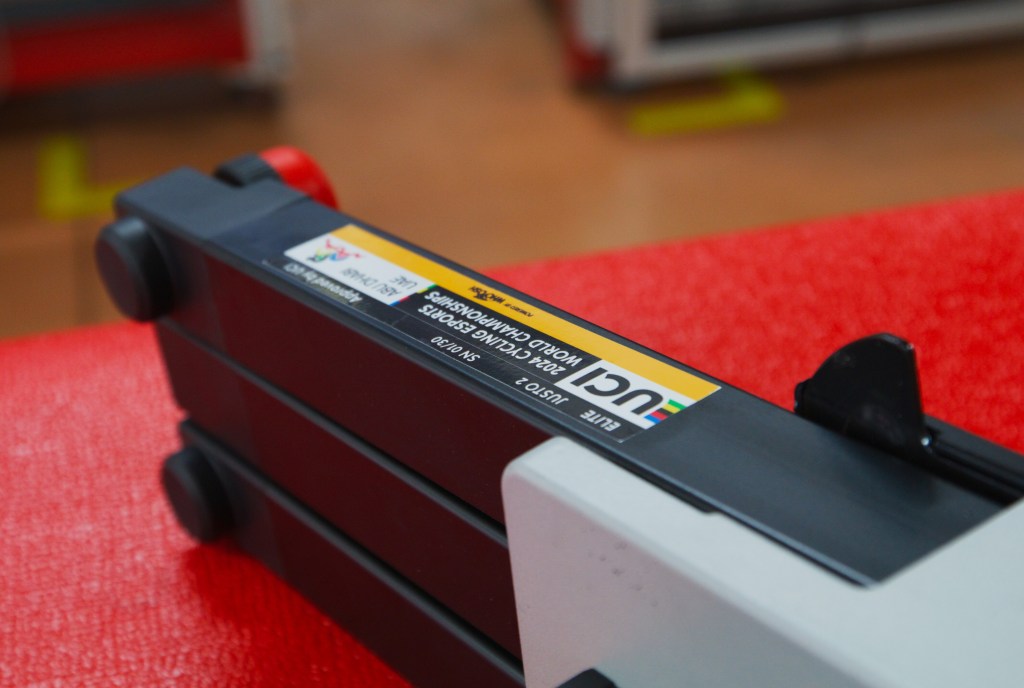
The Cycling Esports World Championship will break new ground in 2024 with the move from Zwift to MyWhoosh and an in-person live event in Abu Dhabi, UAE, on October 26th. The top 20 male and female competitors in the September 6th semi-final will progress to the finals stage, where, for the first time, all of the smart trainers will feature an “Approved by UCI” label, ensuring a 1% power accuracy.
“Extensive testing has ensured that the trainers perform within a 1% margin of equivalence and accuracy, providing confidence in the reliability of comparative performance data. We believe this approach best enables fair competition decided purely by athletic merit. The dedication from MyWhoosh, UCI, and our partners at Elite and the countless hours they invested indicate their profound support for esports as an independent sport discipline. By implementing this initiative, we can ensure equality and fairness, something esports has struggled with until now,” MyWhoosh asserts.
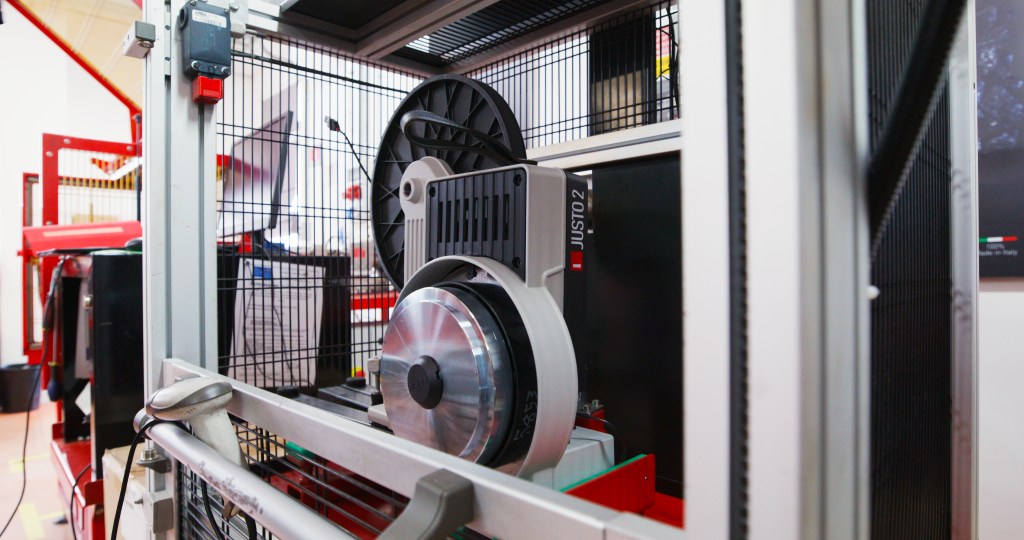
Representatives from MyWhoosh and the UCI met at the Elite Headquarters in Italy the last week in July to accuracy test and standardize the Elite Justo 2 smart trainers the athletes will use in the final.
“Previous editions of the UCI Cycling Esports World Championships have included robust testing and calibration by the manufacturers, and Elite offered to do the same. The UCI wanted to further the testing protocol and parameters to elevate the standardization of the smart trainers in use at the first-ever live final. It is essential that our discipline applies the sporting tenets of fairness and integrity, also to hardware,” said the UCI.
The first three UCI Cycling Esports World Championships hosted virtually on the Zwift platform, saw competitors equipped with hardware sent to them by Garmin-Tacx in 2020 and Wahoo in 2022 and 2023. Elite is the official hardware supplier in 2024.
The 2024 race is poised to set a significant precedent as the host platform, governing body, and hardware manufacturer collaborate to elevate cycling esports to new heights.
“Our goal here is to further develop esports into a standalone cycling discipline that is fair and equitable for all racers. A key aspect of achieving this is to ensure consistent quality across equipment. We are working with Elite to establish the high standards required to achieve this. Athletes will have access to a trainer that has undergone rigorous and uniform testing, giving them confidence that the 2024 UCI Cycling Esports World Championships will be a 100% legitimate competition,” says MyWhoosh.
All athletes who qualify for the live final will be sent a standardized Elite Justo 2 trainer at least four weeks before the event, which will be theirs to keep.
“We aim to provide an experience in which the most important factor is the athletes’ skills and abilities rather than minor variances between their equipment. By October 26th, participants will have an exceptionally fair playing field on which to showcase their talents thanks to identical trainers subjected to the same testing environment,” adds MyWhoosh.
During a January interview in Abu Dhabi, the then Head of Esports, Michael Rogers, disclosed news of the UCI’s smart trainer homologation program, which Cycling News initially reported.
“We are quite advanced in homologation of smart trainers,” revealed Rogers. “We are prepared to announce something within two to three months.”
The UCI partnered with a Purdue University Engineering team led by Prof. Jan-Anders Mansson for the multi-year project, the first of its kind for cycling esports.
Smart trainer homologation involves an independent certification process that assesses the accuracy and reliability of various hardware on the market. In this process, a motor applies a known power to the trainer, which relays data to sensitive torque and rotational measurement sensors.
In Episode 45 of the Virtual Velo Podcast, hosts Chris and Emma sit down with the Purdue University College of Engineering team of Prof. Jan-Anders Mansson and researchers Patrick Cavanaugh and Teal Dowd, who are leading the UCI’s smart trainer homologation and data manipulation program.
This system evaluates a trainer’s baseline and dynamic characteristics, analyzing how it responds to the changing power demands of a race scenario across the full range of an athlete’s performance. The testing protocol includes a fully automated 2 to 3-hour session that checks the power range, resistance accuracy, and the hardware’s response to stress factors like temperature fluctuations.
“The Purdue team and the UCI have a fantastic relationship and one that continues to grow. We are eager to evolve the homologation program and begin implementing it in future competitions and for the market more broadly,” notes the UCI.
However, they haven’t officially rolled out the homologation initiative for this event, but UCI representatives were present to oversee and certify the process using a modified version of the Purdue protocol.
“This verification of the hardware from Elite is a massive step in the right direction for cycling esports, but more work still needs to be done. We are confident this program will inform even greater things to come,” the UCI explained when emphasizing the distinction between standardization and homologation. The UCI isn’t quite there yet.
Each trainer underwent an extensive 1,000 km break-in period to condition all components and thoroughly simulate real-world use. MyWhoosh collaborated with Elite to develop a customized evaluation that simulated the expected power outputs for male and female athletes competing at the World Championships, with power targets set for an average weight of 70-75 kg for men and 55-60 kg for women.
“The process we developed for validating the trainers for the World Championships includes several tests, such as putting our trainers under different conditions, e.g., sprints, accelerations, etc., at various levels of speed and power with our testing benchmarks that we also use for regular production,” explains Elite.
They also equipped each trainer with a high-precision power meter to report and compare the results between the trainer and the nanometer accuracy levels.
Each trainer provided accurate readings that matched these standardized levels and demonstrated highly consistent measurements across different gender and weight classes. It was essential that the trainers offered equitable functionality for all athletes competing in the event.
All 30 trainers selected for the 2024 UCI Esports World Championships perform within 1% of power accuracy. It was all done under the watchful eye of the UCI before being equipped with a tamper-proof cable and boxed for shipping to Abu Dhabi.
“It is critical to ensure that the performance metrics seen by spectators accurately reflect the capabilities of elite athletes, allowing riders at home to make meaningful comparisons to their own power numbers,” says MyWhoosh.
The platform’s financial incentives and challenging race formats attract the top esports talent, and the pro-level performances turn the heads of many skeptical onlookers. The platform takes several steps to demonstrate a commitment to performance authenticity.
MyWhoosh implements thresholds for each athlete based on the pre-verification Power Passport Test and the data MyWhoosh’s team of coaches provides. When a rider who isn’t a World Tour pro exceeds those data points, the system is alerted.
In February 2024, MyWhoosh flew several high-profile elite racers to its headquarters for in-person performance testing.
Based on the in-house testing, the MyWhoosh team confirmed that the data were accurate and that the athletes met or exceeded World Tour numbers according to their calculations. It set a new benchmark for elite-level esports competition, which viewers will likely see surpassed under the bright lights of the World Championship stage when the coveted rainbow bands are up for grabs.
According to the UCI, “This initiative allows us to add a new layer of certainty to the UCI Cycling Esports World Championships. Athletes participating in the live finals, as well as viewers at home, can be assured that all athletes are competing on hardware consistent with each other.”
MyWhoosh believes that hardware certification will demonstrate to spectators how talented these athletes are as the performance bar rises.
“It will prove that the power numbers they are achieving are authentic performances. Showcasing real-time power data in this way allows us to further progress the sport. Now, anyone can reference the world-record power outputs achieved by the best male and female cyclists. Spectators will know what power levels they must attain to match those benchmarks. Displaying the real-time data gives accurate context to these amazing performances.”
By sharing data from esports events, MyWhoosh aims to achieve two primary benefits. First, it educates spectators about their own cycling potential by revealing what professionals are truly capable of. Second, it reinforces the sport’s fairness and equitable nature by demonstrating that the equipment and racing conditions yield authentic and comparable results. Overall, this adds an extra layer of transparency to cycling esports.
MyWhoosh holds all competitors on the platform to the same standard.
Before any rider, regardless of category or gender, can register for a MyWhoosh Premium event, such as the big-money Sunday Race Club, which offers a monthly prize purse exceeding $284,000, they must complete the MyWhoosh Power Passport (PPT). Rolled out in September 2023, the comprehensive performance analysis establishes a baseline power profile for comparison.
To solidify that baseline, all racers competing in the 2024 World Championship semi-finals must complete a PPT and at least two premium events on the MyWhoosh platform.
Over time, MyWhoosh will require certified and standardized smart trainers for all their premium events to ensure authenticity and promote the evolution of the sport.
“It is truly necessary for fair competition. Standardization will expedite cycling esports becoming an Olympic sport and a standalone discipline, separate from traditional cycling. Certainly, certification and standardization will be crucial moving forward, both for MyWhoosh and esports in general,” MyWhoosh insists.
Guaranteeing a level playing field for all 2024 World Championships racers through the smart trainer testing and certification initiative demonstrates to the community that MyWhoosh and Elite are taking cycling esports seriously.
It’s also an invaluable opportunity for the UCI to assert its position as the sport’s governing body and guide technological advancement, building on this initiative’s proof-of-concept example.
“We are looking at this testing program as a real-world data set that will further inform the broader homologation program and provide a data point for the athletes competing in the live final. We plan to demonstrate that it is possible to validate that current hardware manufacturing processes and software development can establish a level playing field for all athletes,” confirms the UCI.
Cycling esports racers and enthusiasts argue, and the UCI affirms, “This is one, if not the most, important pillar to further develop cycling esports.”
Semi-retired after more than 20 years as the owner and director of a private Orthopedic Physical Therapy practice, Chris now enjoys the freedom to dedicate himself to his passions—virtual cycling and writing.
Driven to give back to the sport that has enriched his life with countless experiences and relationships, he founded a non-profit organization, TheDIRTDadFund. In the summer of 2022, he rode 3,900 miles from San Francisco to his “Gain Cave” on Long Island, New York, raising support for his charity.
His passion for cycling shines through in his writing, which has been featured in prominent publications like Cycling Weekly, Cycling News, road.cc, Zwift Insider, Endurance.biz, and Bicycling. In 2024, he was on-site in Abu Dhabi, covering the first live, in-person UCI Cycling Esports World Championship.
His contributions to cycling esports have not gone unnoticed, with his work cited in multiple research papers exploring this evolving discipline. He sits alongside esteemed esports scientists as a member of the Virtual Sports Research Network and contributes to groundbreaking research exploring the new frontier of virtual physical sport. Chris co-hosts The Virtual Velo Podcast, too.