Coordinate your hormones, cycling, and fitness training program for maximal gains and, more importantly, a healthier life.
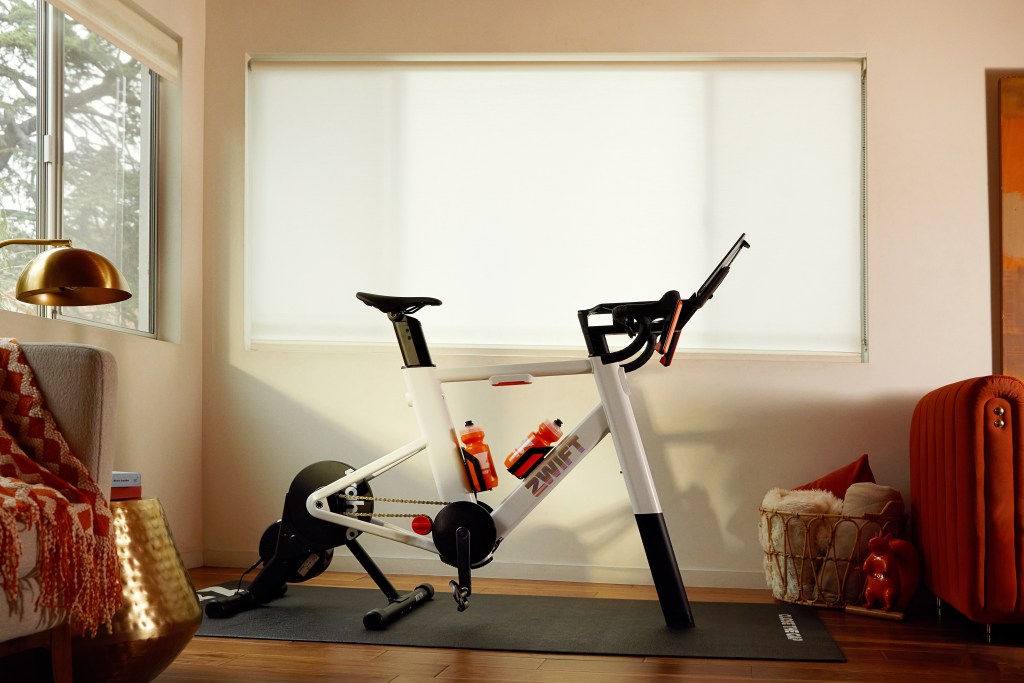
Imagine a virtual training world where you can ride with a supportive and inspiring community. Set your weight, height, and gender to ride with appropriate resistance and race algorithms within proper categories. Choose your lycra, machinery, and hairstyle, and even personalize your features to a degree. Oh, wait! You can!
Now imagine taking this concept one step further and personalizing it for the stages of a woman’s cycle or life. Cycle personalization can potentially change things profoundly, permitting us and teaching us how to take the pressure off ourselves and improve performance in the long run.
We Set The Bar, and We Set It High
Our society conditions women to grow up in a competitive, male world. For many of us, that has always been a driving force. As a youngster, I was a competitive diver, always striving to be as good as some of my male teammates so I could pair with them. I was also a fast runner–outrunning most girls, so naturally, the boys became my next target.
Fast-forward a few decades, and I have become a fast cyclist. Overtaking “the boys” on climbs fuels my fire to casually overtake them and say “hi,” much to their disgruntlement as they huff and puff when they see my group coming. Does this resonate with you?
Although this driving force is endearing and can help us become great achievers, it is also detrimental to us in the long term. With that experience, we set the bar, and it is set high.
Our Mind and Body Work Against Each Other
It can become a case of mind and body working against each other, with no rest throughout the month, or taking a scheduled rest week in a training program when our hormone levels are optimum for our bodies to build strength and endurance. Eventually, this can invite chronic health conditions to the training scene.
If I had been taught at a young age how the female menstruation cycle works, I could have treated my body with more respect. Whether someone is fast, slow, or just having fun, the ebb and flow of hormones determines their ability throughout the month.
Essential Cycling With Your Menstrual Cycle Facts
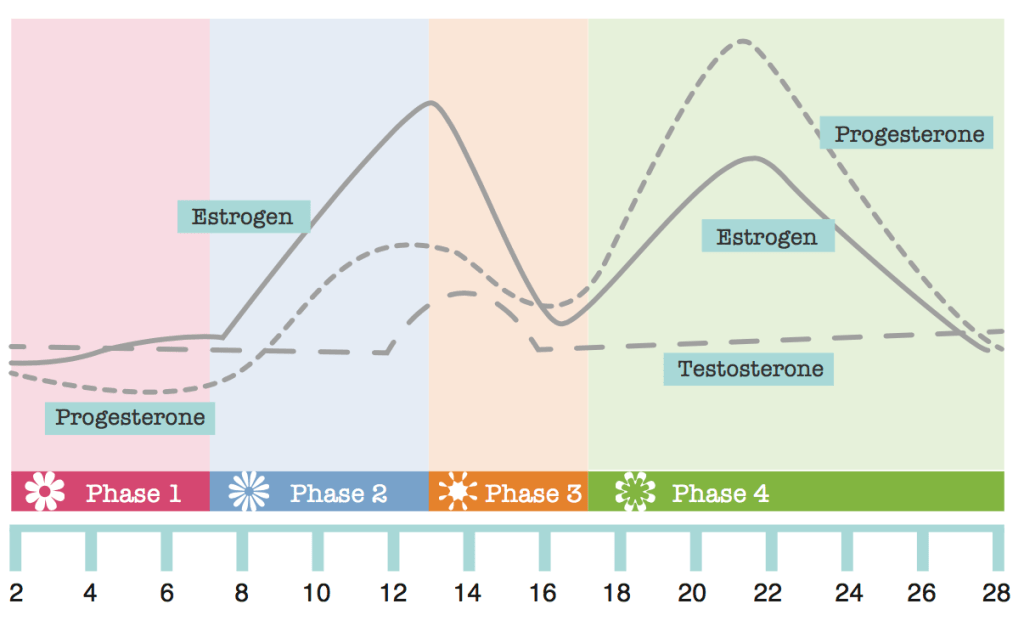
During an average menstrual cycle of 28 days (23-35 days is normal), hormone levels peak and valley. If we work against these drops, we create systemic stress and increased inflammation that becomes difficult to clear.
Let’s take a quick stop at our bank of hormones: estrogen, testosterone, and progesterone. If someone is premenopausal, each of these should have a healthy cycle of highs and lows throughout the month.
We have estrogen receptors on almost every cell in our body, keeping our tendons supple, firing muscles, increasing collagen production, and keeping our cardiac, bone, and brain health in tip-top shape. Testosterone supports muscle recruitment, bone health, metabolism, motivation, and energy. Testosterone also plays a role in feeling joy.
Cycling With Your Menstrual Cycle: Day 1 to Day 14
These two hormones work in unison, gradually increasing from day 1 of our cycle and peaking around day 14. It is the most productive point of the month when the body can handle more intensity, recover quickly, and repair and build muscle efficiently. It is the time to pack in those extensive cycling sessions and heavier strength training to complement your riding and offset the hours spent in a forward-flexed position that cycling puts us in.
Cycling With Your Menstrual Cycle: Day 14 and Beyond
Following day 14, these two hormones begin to decline as progesterone rises. The increase is in anticipation of a fertilized egg supporting the uterus for potential embryonic implantation. Progesterone makes us sleepy, and it requires glucose, causing us to crave carb-rich foods. Water retention also occurs, and the scale goes up. The best part is that this is entirely normal, albeit uncomfortable and sometimes discouraging. It slows us down and prepares us for the growth of a baby.
Progesterone’s increase works in unison with the drops in estrogen and testosterone, so our muscles will not recruit as well or recover as efficiently. You are also more prone to injury as collagen production decreases.
If we train during weeks 3-4 of the cycle, we work against the natural ebb and flow of our hormones. This increases the release of the stress hormone cortisol, which adds more inflammation to our system. Elevated inflammation levels can harm our health, impacting our metabolism and the thyroid gland, which regulates energy. This disruption can affect the production of estrogen, testosterone, and progesterone.
Weight gain becomes the “norm” under this level of stress. As cortisol rises in readiness for us to escape from the clutches of everyday life or compete on race day, cells reduce their capacity to absorb insulin and glucose, raising blood sugar levels, which can cause weight gain.
Many endurance athletes are stuck in the mindset of “I must ride today to keep up with fitness goals,” but understand that you will only be aiding the opposite outcome during this phase.
Also Read:
What Can You Do To Make Cycling With Your Menstrual Cycle Work In Your Favor?
How do we plan for our bodies? Track your menstruation cycle–if it is regular. Begin by setting up a schedule around it that allows you to adapt without pressure and plan your rides on your favorite esports app to accommodate and encourage this.
Be prepared to flex. Go for a walk if you’re not feeling motivated. Or take your bike out in the real world for a gentle spin, taking in nature for a recovery ride and some cake–progesterone wants carbs, so cake while on a ride is favorable in the long run. Your nervous system will thank you for it.
Add more yoga or Pilates during this phase. Your lymphatic system will welcome the chance to move lymph away from stagnation during this phase of your cycle.
Cycling With Your Menstrual Cycle CliffsNotes
Here are the CliffsNotes to help the schedule stick:
- Day 1-5 Menstrual Phase—estrogen, testosterone, and progesterone are low.
- Day 1 of your cycle is bleed day.
- We begin to feel better since progesterone has dropped, and estrogen and testosterone have begun to increase.
- It’s time to gradually start building up sessions, depending on how you feel.
- Day 6-14 Follicular Phase—estrogen and progesterone are rising.
- It is a great time to bank on energy levels increasing to support training.
- Day 15-17 Ovulatory Phase—estrogen and testosterone levels are at their highest and progesterone is also high.
- It’s a perfect time for long endurance sessions and maximal strength training sessions. Your body will clear the inflammation created with greater ease, and muscle fibers will be working at their optimum.
- Day 18-28 Luteal Phase—estrogen rises again after a drop following ovulation, and progesterone is at its highest level.
- Progesterone rules the roost! Estrogen is also quite high, and testosterone is at its lowest level, which equals longer recovery time and low-level duties. Eat healthy carbs, eat before training, love your body, and get to know it in other ways. She will pay you back with better endurance and strength the following month.
- If you feel well, training at a lower level is fine. However, the optimum output for your muscle fibers will have already occurred, and they’ll be looking for more rest. The physiology of muscle strengthening, at its simplest, is to stress the muscle and create low-level damage, then rest it while it repairs and increases in strength.
Harness the Power of Cycling With Your Menstrual Cycle
Hopefully, you can see the cycle that you have the potential to create.
Understanding and working with your body’s natural cycles is crucial for optimizing performance and overall health. Intense exercise and fasting can disrupt these cycles, like putting the wrong fuel in your car or neglecting bike maintenance before a race.
Virtual cycling offers a unique advantage over real-world cycling by allowing us to train within our optimal muscle function throughout the month, maximizing results and holistic health. It empowers us to listen to our bodies and rest when needed.
In the future, cycling esports may even incorporate algorithms tailored to menstrual cycles, enabling more innovative training strategies for long-term success.
Hi, I’m Claire Willett. Owner of Millstream Pilates Ltd and The Menopause Couch © Ltd.
I’m a movement specialist and Menopause Coach. I am also qualified in Pilates for performance, cycling, and running.
I am a lover of all bikes and have completed a Tour de France ‘Etape’ and a Giro d’Italia Maratona, and I am a member of the Club des Cingles for climbing Mont Ventoux 3 times in a day. I’ve gravel biked the King Alfred’s Way, MTB’d The Pennines Way, and am about to embark on the Trans Snowdonia.
Virtual cycling has been a part of my training support for many years, but it has also been a lifeline for rehabilitation when I’ve most needed it due to both scheduled and unexpected surgeries, Premature Ovarian Insufficiency, and Thyroid Autoimmune disease. It’s kept me sane with graduated and progressive fitness in the privacy of my pain cave.
It’s recently become more than that with Zwift, now becoming a part of an amazing community of supportive women in Team Fearless.
Follow Claire on Instagram at @menopause_couch!
Semi-retired after more than 20 years as the owner and director of a private Orthopedic Physical Therapy practice, Chris now enjoys the freedom to dedicate himself to his passions—virtual cycling and writing.
Driven to give back to the sport that has enriched his life with countless experiences and relationships, he founded a non-profit organization, TheDIRTDadFund. In the summer of 2022, he rode 3,900 miles from San Francisco to his “Gain Cave” on Long Island, New York, raising support for his charity.
His passion for cycling shines through in his writing, which has been featured in prominent publications like Cycling Weekly, Cycling News, road.cc, Zwift Insider, Endurance.biz, and Bicycling. In 2024, he was on-site in Abu Dhabi, covering the first live, in-person UCI Cycling Esports World Championship.
His contributions to cycling esports have not gone unnoticed, with his work cited in multiple research papers exploring this evolving discipline. He sits alongside esteemed esports scientists as a member of the Virtual Sports Research Network and contributes to groundbreaking research exploring the new frontier of virtual physical sport. Chris co-hosts The Virtual Velo Podcast, too.