Devoted Wahoo-RGT subscribers reveal their new virtual digital destinations: Here are the 5 best virtual cycling platform options according to a poll
When the virtual cycling platform Wahoo-RGT (known then as Road Grand Tours) entered the landscape in 2018, users welcomed the rival option to market leader Zwift. RGT’s responsiveness to user-generated feedback, real-world physics focus, movement away from gamification, and nimble progressiveness and innovation quickly positioned the app as the anti-Zwift.
RGT’s loyal community embraced the opportunity to be a part of something different that appeared motivated for the right reasons. The digital stage was set for a virtual cycling arms race as Zwift and RGT traded shots in a battle for one-upmanship. With each update, the platforms raised the standard for virtual cycling, and the user benefitted from the competition.
In stepped Wahoo, one of the leading technology companies for the endurance athlete and cycling industry known for their KickR smart trainers, who in April 2022, acquired RGT to stand beside Wahoo SYSTM as an integrated platform, Wahoo SYSTM.
Wahoo appeared poised to place significant emphasis on RGT’s “Magic Roads” feature, enabling users to generate routes based on uploaded real-world files quickly. The focus aimed to enhance the platform’s versatility and user experience.
While some in the grassroots RGT community were puzzled by the move, there was potential.
In contrast to Zwift, which allocates tens of millions of dollars to marketing annually, RGT operated on a shoestring budget and accomplished extraordinary things. Who knows what Wahoo’s financial support could do for the evolving platform?
Following the acquisition, Wahoo implemented several improvements, including the addition of voice chat (unlike Zwift) and the introduction of dedicated steering functionality using the Wahoo KICKR STEER hardware, controlled via a smartphone. These enhancements made RGT particularly popular among a niche group of competitive riders who appreciated the platform’s race tactics features and the Magic Roads functionality [DC Rainmaker, October 2, 2023].
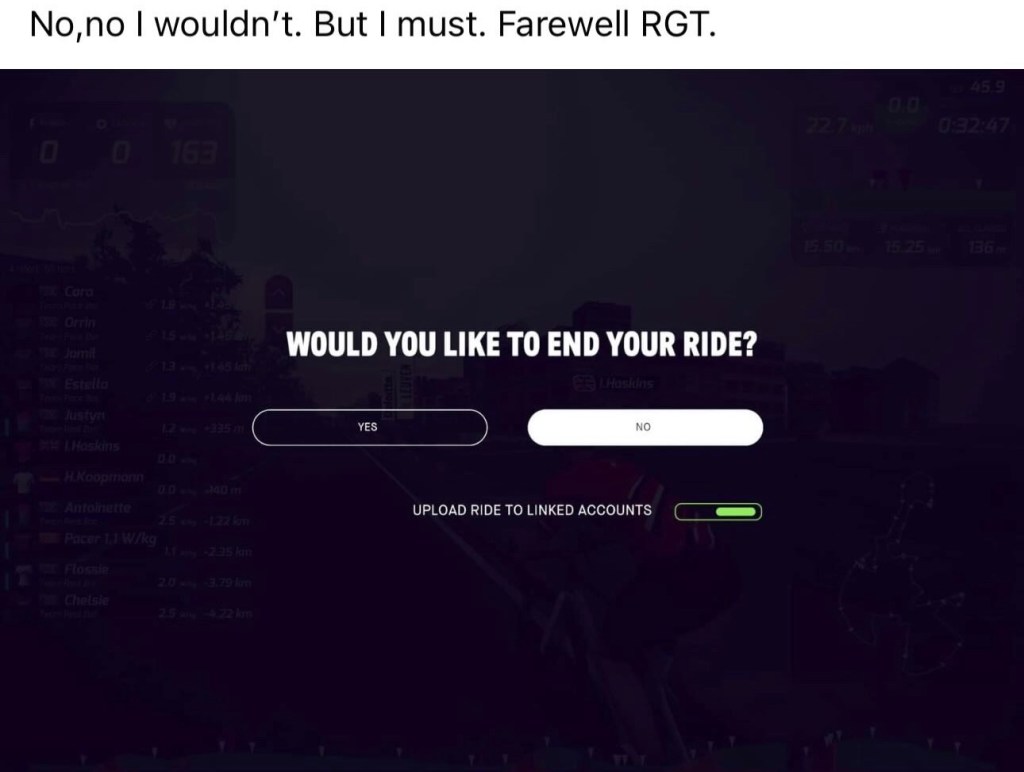
The future was bright until it wasn’t. Despite the fierce loyalty of RGT’s user base, the platform’s growth lagged behind, and so did Wahoo’s attention to their platform pet project. Wahoo shut the doors on RGT users on October 31, 2023, and in a statement, citing a renewed focus on structured training content. The community was less than content and left searching for a replacement.
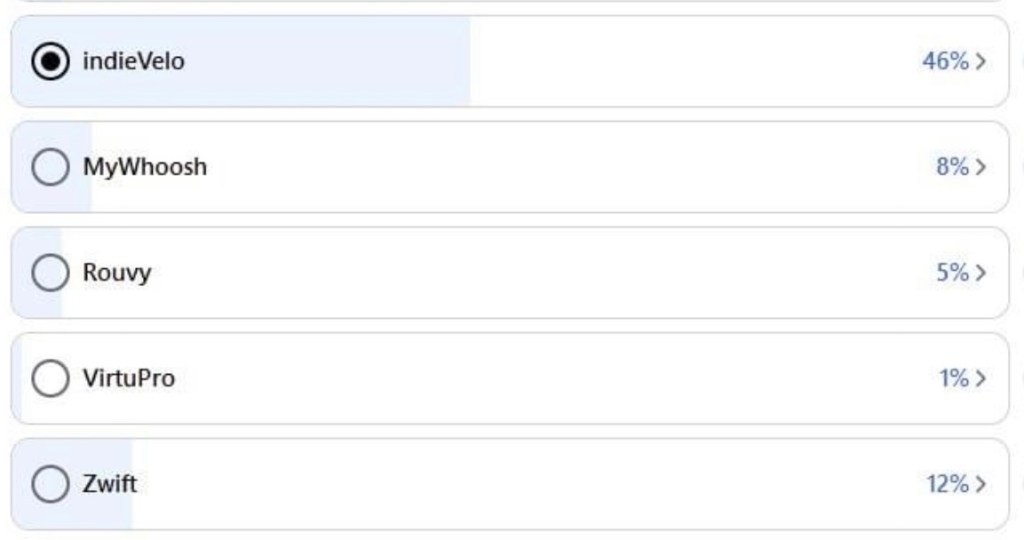
An impromptu poll on the 11.4 thousand member “RGT cycling – users” FaceBook group asked the straightforward question, “Where will you go?” The answers might surprise you.
#1: indieVelo
Forty-six percent of the RGT users polled picked the Beta platform, indieVelo. However, the reasons aren’t a mystery when you put the platforms side-by-side.
Both utilize the Unity gaming platform and Server-Authoritative architecture. The software engine facilitates rapid function and feature updates. Server-side means everyone sees the same thing on their screen, and all race results are accurate.
It’s one of the primary reasons RGT was the go-to platform for cycling esports racing purists, along with what was considered the best game physics around.
Innovating the technology of cycling esports is indieVelo’s primary focus and the driving force behind their proprietary RPTR Engine ™—Ride, Pace, Train, Race. The engine is grounded in the principles of physics, ensuring that riders must abide by the fundamental laws of nature.
Like RGT, indieVelo’s physics engine accounts for cornering speed and auto-braking, and the Beta platform introduces wind and weather for an additional layer of dynamic realism.
Unlike RGT and all other virtual cycling options, indieVelo doesn’t display the power-to-weight ratio (wkg) of riders. Instead, indieVelo shares data that mirrors real-world racing—the speed of other riders and their relative physical effort compared to you. indieVelo displays the speed of every racer on the rider list. In addition, indieVelo also steps away from power-based categorization, utilizing an Elo-like results-based rating system.
The developer, Dr. George Gilbert, an astrophysicist and former Chairman of the Zwift Cycling Esports Commission, created the platform with racing in mind, integrating systemic anti-cheat systems, like built-in dual recording and more robust data.
However, racing isn’t every RGT user’s priority, and the AI-enhanced Bots that populate indieVelo’s limited course offering don’t sit well with some. The graphics are good, but the developer prioritizes solidifying the platform’s infrastructure over polishing the bells and whistles and slowing innovation. It’s also why you won’t be able to get it on your Apple TV. The app isn’t yet available for Apple TV, iPad, iOS mobile, or Android, but there are plans for future compatibility.
PROS: Tactics, Authenticity, and Nimble Progression
CONS: Graphics, Device Limitations, and more Bots than Humans
BEST FOR: Competitive Cycling Esports racers that value robust performance verification and an engaging race experience.
COST: Presently Free to Use, Optional $12.99/month subscription to Founder’s Club
#2: Zwift
Zwift was the answer that 12 percent of the RGT users gave. The critical crowd will say it’s because of the Zwift subscription deal Wahoo offered current RGT paid subscribers. Others will admit that Zwift is where most of their virtual cycling friends are.
Let’s face it: Zwift has cornered the market on critical mass and market share. There’s a strong sense of community and socialization. Many will admit that it is for a good reason, but for different reasons than they would choose the other options.
Created in 2014, Zwift had a head start and grew to become the standard by developing a diverse product that appeals to the masses. Zwift leans heavily into gamification, depicted in the platform’s artistic fantasy-world graphics and evolution towards Mario Kart-type gameplay.
The company’s hardware offerings, like the Zwift Hub One, Zwift Cog + Click, and Zwift Play, make setup straightforward and enhance the video game feel. There’s something for everyone on Zwift, and you will always find a fellow avatar or timed sprint segment for motivation.
For many RGT users, the Jack-of-all-trades mentality and just a number perception was a turnoff. Zwift’s proprietary game engine, the client-side architecture where what you saw on your screen wasn’t what others saw, and the lack of systematic anti-cheat systems defied the sensibilities of the competition-oriented crowd.
PROS: Community, Proven Track Record, Diverse Offering, Gamification
CONS: Broad focus makes users feel unheard
BEST FOR: Indoor riders who value camaraderie and enjoy the motivation of being immersed in a virtual world.
COST: $14.99 / £12.99 per month
#3: MyWhoosh
The competitive RGT users made up the 8 percent that mentioned they’d moved on to MyWhoosh. Founded in 2019 in Dubai, the platform promised to prioritize high-level esports racing and embraced the evolution of the sport as a legitimate distinct discipline from the start.
The platform is known for hosting big-money events, like the weekly Sunday Race Club series, with a monthly prize purse of over $90,000 spread across three categories, two genders, and team and individual classifications. The $1 Million MyWhoosh Championship series in April 2023 boasted the largest payout in cycling esports’ history.
The UCI entrusted the Cycling Esports World Championships to MyWhoosh for the next three years. MyWhoosh will serve as the sole organizer for the 2024 to 2026 championships, including qualifying rounds and a live final in Abu Dhabi. MyWhoosh is the official indoor cycling platform of the World Tour UAE Team Emirates and its star rider, Tadej Pogačar.
There is heavy investment in the platform’s top-notch graphics and engaging range of extensive routes. Their mission is to legitimize cycling esports by pioneering innovations and advancing industry standards for validation, verification, and categorization. In each elite-level event, MyWhoosh automatically subjects every racer to its proprietary performance verification system.
MyWhoosh employs a dynamic categorization model, with race organizers setting limits based on registered participants and historical data to minimize inadvertent miscategorization. MyWhoosh calculates rider position server-side, eliminating the inaccurate finish line visuals issues found on other platforms.
While MyWhoosh continues to refine its physics and draft mechanics, they have yet to achieve the same level of realism as platforms like Zwift or indieVelo. The lofty minimum device specs are a barrier to entry, and there is presently no support for Mac or Apple TV. Also lacking is the community feel, overshadowed by the competitive quest for a big payout.
PROS: Esports focus, Significant Prize $ potential, Pro Team Partnership, UCI Cycling Esports World Championship Host, Graphics
CONS: Money is the Root of Evil, Lack of Community Feel, Disconnect with User Base, Device Specs and Limitations
BEST FOR: Elite and highly competitive Cycling Esports athletes driven by cash payouts and excited by the investment potential and UCI focus.
COST: Free to use
#4: ROUVY
Five percent picked the Czech company ROUVY, founded in 2017. The platform is motivated to carve out its place in the virtual landscape by asking in a recent promo, “When you’re riding indoors, why limit yourself to a minuscule computer-generated world when you can explore the real world instead?”
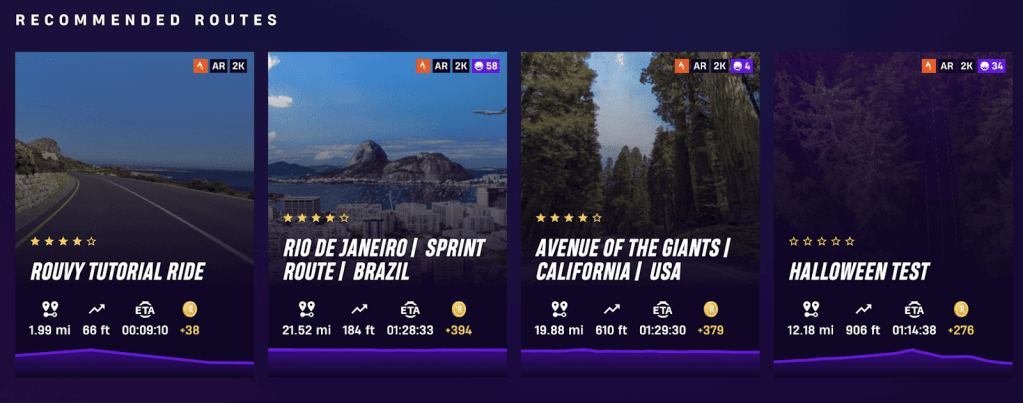
ROUVY’s mission is to “Bring the Outdoors Home” by providing users with the opportunity to ride, race, and train on some of the world’s most picturesque routes. To achieve this, ROUVY incorporates real-world videos of iconic scenery, challenging climbs, and renowned race courses from around the globe into its extensive route database. This approach gives riders the sensation of genuinely ascending famous mountains like L’Alpe-d’Huez rather than merely simulating the experience on a platform like Alpe du Zwift.
ROUVY provides users access to a wide selection of meticulously curated routes, numbering over 9,100, representing 100 countries. The platform offers an extensive landscape of more than 245,000 km for cycling enthusiasts to explore, along with the inclusion of 975 Strava Live segments for added convenience.
A noteworthy feature of ROUVY is its Augmented Reality (AR) capability, which brings a heightened level of realism to the virtual cycling experience. AR seamlessly integrates 3D riders into actual video footage, creating a bridge between the virtual and real worlds. ROUVY boasts an extensive selection of over 1,000 AR routes spanning 45 countries, covering more than 30,000 km and 622,000 m of elevation gain.
ROUVY has undergone a significant visual overhaul, featuring a sleeker and more modern appearance, along with a fresh color scheme that reflects the app’s commitment to resource allocation and future development.
The transformation aligns with recent enhancements to the user interface and user experience (UI/UX), bringing numerous improvements to the core functionality, video playback, and overall technical performance. ROUVY is committed to personalizing the user experience through AI algorithms trained to user trends.
By focusing on the core experience, the app is trying to eliminate the technical glitches and video playback issues that plagued users in the past. ROUVY does many things that the other options do, and they try to do it well. They’re not quite there, but ROUVY is worth another try.
PROS: Realism, Extensive Route Library, Virtual Reality, Ability to Ride the World’s Iconic Climbs
CONS: Past Technical Issues, Still Developing Users and Community
BEST FOR: Riders who want to get real when they can’t get outside.
COST: $14.99/month
Honorable Mention: TrainerRoad
RGT and all of the other potential options have workouts and training plans. Yet, few users tapped TrainerRoad as their RGT replacement despite training being a primary focus of indoor riding motivation. TrainerRoad is worth mentioning as a valuable alternative.
TrainerRoad distinguishes itself with a vast database comprising more than 250 million activities recorded by athletes across 150 countries. What sets it apart is its extensive collection of over 25 million specific TrainerRoad workouts.
These “planned vs. actual” workout data contribute to the platform’s AI and machine learning capabilities, offering exclusive insights that give TrainerRoad a competitive advantage in AI-driven cycling coaching.
The app’s automated Training Plan Builder and integrated calendar offer a level of workout organization and flexibility not found on the other platforms.
TrainerRoad does one thing and does it very well. There is no free riding, racing, or in-game socialization. However, the endurance community holds their free educational podcast and YouTube content in high regard. The “Ask a Cycling Coach Podcast” is among the most popular cycling podcasts.
PROS: Training-specific, Adaptive Training, Well-Organized Workout Calendar
CONS: No Free Riding, Races, or Group Rides
BEST FOR: Riders who want structured training and can entertain themselves.
COST: $19.99/month
The Choice Isn't Easy
Initially, the decision for RGT users was reasonably straightforward, with essentially two distinct paths to choose from. However, the virtual cycling landscape is expanding, bringing healthy competition that benefits consumers. It’s a difficult decision, and that’s a good thing!
We wish the RGT community all the best in discovering the virtual cycling experience that leads to their happiness on the magic road ahead.
To subscribe to the Zommunique and receive more informative and entertaining articles like this one sent directly to your inbox, click here!
Semi-retired after more than 20 years as the owner and director of a private Orthopedic Physical Therapy practice, Chris now enjoys the freedom to dedicate himself to his passions—virtual cycling and writing.
Driven to give back to the sport that has enriched his life with countless experiences and relationships, he founded a non-profit organization, TheDIRTDadFund. In the summer of 2022, he rode 3,900 miles from San Francisco to his “Gain Cave” on Long Island, New York, raising support for his charity.
His passion for cycling shines through in his writing, which has been featured in prominent publications like Cycling Weekly, Cycling News, road.cc, Zwift Insider, Endurance.biz, and Bicycling. In 2024, he was on-site in Abu Dhabi, covering the first live, in-person UCI Cycling Esports World Championship.
His contributions to cycling esports have not gone unnoticed, with his work cited in multiple research papers exploring this evolving discipline. He sits alongside esteemed esports scientists as a member of the Virtual Sports Research Network and contributes to groundbreaking research exploring the new frontier of virtual physical sport. Chris co-hosts The Virtual Velo Podcast, too.

Also, two new apps :
Cr4nkup
Rolla
MyWhoosh is too demanding on hardware capabilities.
Thanks for those suggestions! MyWhoosh recently updated their minimum hardware requirements and introduced MacOs too.