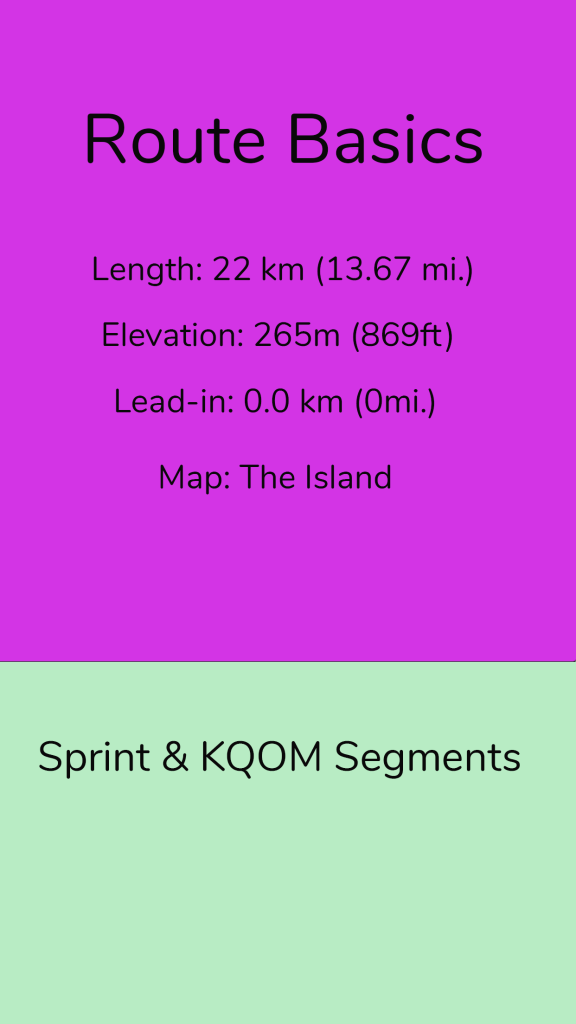
indieVelo's Parry Vlo-Bae Reverse is a reverse version of Parry Vlo-Bae, covering a total distance of 22 km (13.67 mi) with an elevation gain of 265 m (869 ft).
Route Description
Parry Vlo-Bae Reverse represents one of the three variations of the Parry Vlo-Bae route launched with the v0.2.25 release on November 27, 2022. Much like the original route, it embodies the spirit and values of the spring classics and monuments, commencing and concluding at the Velodrome, despite the absence of cobbles on the island.
As the name suggests, Parry Vlo-Bae Reverse is a reverse version of Parry Vlo-Bae, covering a total distance of 22 km (13.67 mi) with an elevation gain of 265 m (869 ft).
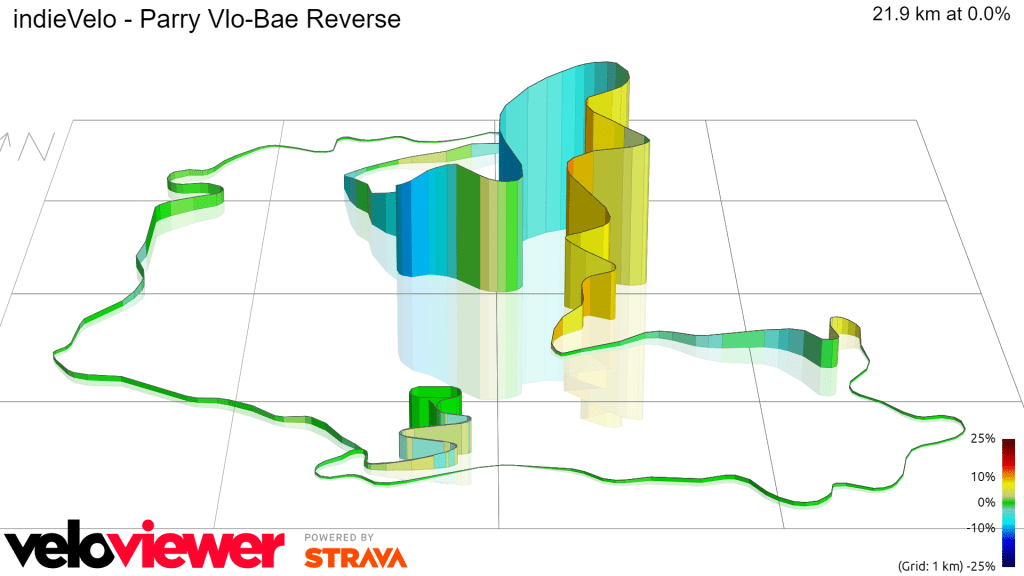
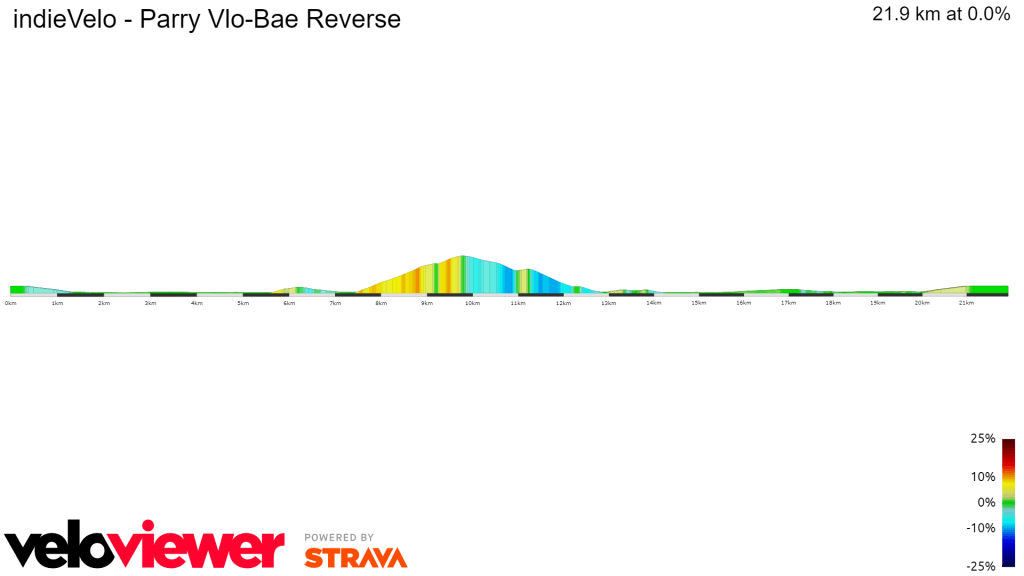
After descending the Velodrome hill, there is a 4 km (2.49 mi) flat section preceding a slight bump of 600 m (1969 ft) at approximately 4% gradient, which serves as a warm-up before tackling the main challenge of the day at km 7.7 (4.78 mi).
The Switchback Hill climb is 2.3 km (1.43 mi) long with an average gradient of 6.9%, featuring peaks at 11%. The climb maintains a consistent gradient between 8% and 10% during the initial 1.5 km (0.93 mi). Spoiler alert: The discomfort in your legs will match the gradient, but it will be closer to 100%.
Then, for 250 m (820 ft), you may feel like you can catch your breath at 3%. A better option might be to summon all the gods and goddesses you can think of in preparation for the climb’s final 500 m (1640 ft), which ranges between 8% and 10% gradient with peaks at 14%.
In stark contrast to the Parry VLO-bae forward routes (both original and lite), the KOM is quite distant from the banner. Therefore, one should not underestimate the lengthy 7 km (4.35 mi) flat segment following the descent of the KOM, where large groups will have a significant advantage over small breakaways.
At km 20.3 (12.61 mi), the 1 km (0.62 mi) hill with a 2.5% gradient just before the Velodrome is the last opportunity to make a move against riders still in the pack with you.
Once at the top, remember that you must complete 1.5 laps of the Velodrome to finish the route, meaning you must pass the Velodrome banner twice.
One last tip: on numerous occasions, the KOM is not the most pivotal moment in the race. Just before km 18 (11.18 mi), the road splits into two at a roundabout. The peloton will also split into two, with one group going left (upper deck) and the other going right (lower deck).
For approximately 600 m (1969 ft), these two groups are out of each other’s sight. It’s not uncommon for this to be the precise moment when one of the groups decides to initiate a substantial breakaway. This maneuver is known as a “Bjoerninha,” named after one of the creators of indieVelo, renowned for his roundabout strikes.
Therefore, if you wish to avoid falling behind and experiencing regret, remain vigilant during those 600 m (1969 ft) and collaborate with your group to collectively accelerate, preventing being left behind by a Bjoerninha attack.
Route Profile
Route details and description courtesy of Beta-tester Rob Miller!
Check out the indieVelo-Route Descriptions page for more useful recon information.
Semi-retired after more than 20 years as the owner and director of a private Orthopedic Physical Therapy practice, Chris now enjoys the freedom to dedicate himself to his passions—virtual cycling and writing.
Driven to give back to the sport that has enriched his life with countless experiences and relationships, he founded a non-profit organization, TheDIRTDadFund. In the summer of 2022, he rode 3,900 miles from San Francisco to his “Gain Cave” on Long Island, New York, raising support for his charity.
His passion for cycling shines through in his writing, which has been featured in prominent publications like Cycling Weekly, Cycling News, road.cc, Zwift Insider, Endurance.biz, and Bicycling. In 2024, he was on-site in Abu Dhabi, covering the first live, in-person UCI Cycling Esports World Championship.
His contributions to cycling esports have not gone unnoticed, with his work cited in multiple research papers exploring this evolving discipline. He sits alongside esteemed esports scientists as a member of the Virtual Sports Research Network and contributes to groundbreaking research exploring the new frontier of virtual physical sport. Chris co-hosts The Virtual Velo Podcast, too.