- August 17, 2021
- 2 Comments
Bridge the gap between your trunk and the pedals by following this Bridge Core Exercise strengthening progression.
The Bridge Core Exercise is a great exercise for cyclists because it works some important lower body muscles while strengthening the core. The target muscle is the erector spinae that runs along the spine, but the bridge also engages many deep spinal stabilizers.
Most notable to the cyclist looking for an efficient way to utilize their out of the saddle time, the bridge works the posterior chain muscles, including the hips, glutes, and hamstrings.
When performed correctly as a strict isolation exercise, the bridge also engages the anterior chain muscles, like the rectus abdominis, obliques, and quadriceps, as they stabilize the spine further while counteracting the upward forces.
Key Tips for Proper Bridge Core Exercise Form
- Start by lying on your back with knees bent and flatten your pelvis, and low back down to the floor.
- Brace and hold this position as you raise your buttocks off the floor.
- Do not allow your low back to arch upwards for the entire exercise and maintain a neutral spine.
- Relax your head and neck and keep your chin tucked to avoid neck strain.
- Stabilize your shoulders on your torso by tucking in your shoulder blades.
- Squeeze your thighs and glutes.
- Brace your core, stabilize your spine, and breathe comfortably throughout the exercise.
- Perform in a slow and controlled manner.
Common Mistakes to Avoid When Doing Bridge Core Exercises
- Avoid raising your hips too high because hyperextending your lower back can lead to strain.
- If you find your hips are dropping as you try to hold the bridge position, lower your pelvis back down to the floor and try again.
- Don’t arch your back or let it rise from the surface on which you are exercising. If it does, then take a break and start over.
- Don’t let your spine or trunk twist or rotate.
- Don’t strain your neck by lifting it up or to the side.
- Don’t let your shoulder blades wing out by keeping your shoulders stabilized on your ribs.
- Absolutely do not hold your breath.
Bridging
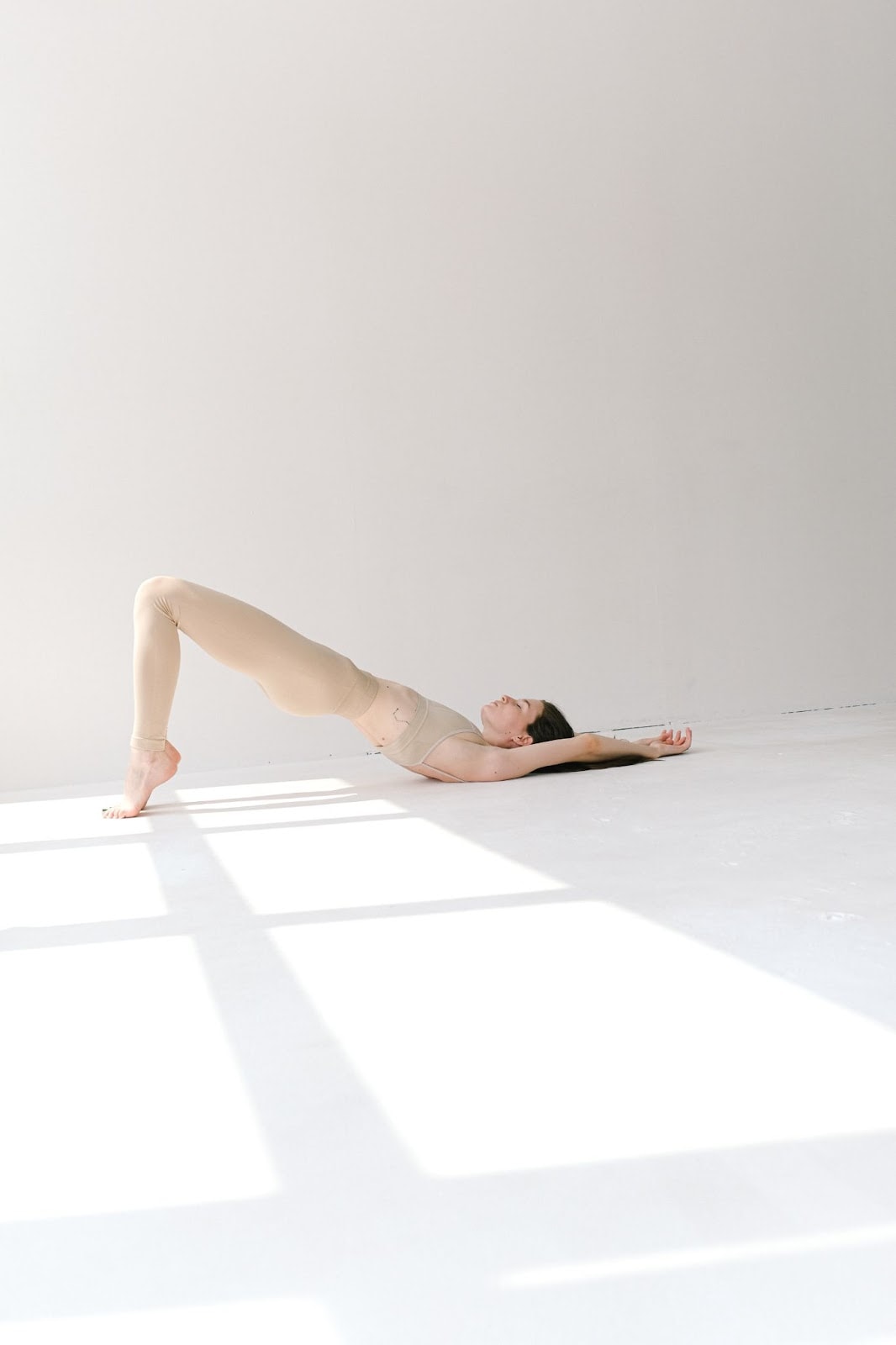
While lying on your back with knees bent, tighten your lower abdominals, squeeze your buttocks, and then raise your buttocks off the floor while creating a “Bridge” with your body.
Hold and then lower yourself and repeat.
Bridge with Alternate Knee Extention
While lying on your back, raise your buttocks off the floor into a bridge position.
Next, raise and straighten one knee so that only the other leg is supporting your body.
Then, return that leg to the floor and then alternate and perform on the other leg.
Bridging with Crossed Leg
While lying on your back, cross your leg as shown.
Next, tighten your lower abdominals, squeeze your buttocks, raise your buttocks off the floor, and create a “Bridge” with your body.
Bridging Crossed Leg with Arms Up
While lying on your back, cross your leg and put your hands together as shown.
Next, tighten your lower abdominals, squeeze your buttocks and raise your buttocks off the floor while creating a “Bridge” with your body.
Conclusion: The Bridge Core Exercise Series
The Bridge is an effective, safe, and simple exercise for building core strength and improving spinal stabilization and can be an excellent place for the beginner core strengthening cyclist to start. The ability to include the bridge in your lower body strengthening program is appealing to the cyclist who finds training time to be at a premium.
When variations to the bridge make it more challenging, like performing on one leg, you are forced to resist spinal rotational forces, much like those faced during sprinting and hard climbing efforts. All in all, the bridge is a good exercise for the cyclist to consider when budgeting their off the bike training minutes.
For this and many other Core Strength Exercise Progessions check out our Strength & Conditioning page!
To subscribe to the Zommunique and receive more informative and entertaining articles like this one sent directly to your inbox, click here!
Semi-retired after more than 20 years as the owner and director of a private Orthopedic Physical Therapy practice, Chris now enjoys the freedom to dedicate himself to his passions—virtual cycling and writing.
Driven to give back to the sport that has enriched his life with countless experiences and relationships, he founded a non-profit organization, TheDIRTDadFund. In the summer of 2022, he rode 3,900 miles from San Francisco to his “Gain Cave” on Long Island, New York, raising support for his charity.
His passion for cycling shines through in his writing, which has been featured in prominent publications like Cycling Weekly, Cycling News, road.cc, Zwift Insider, Endurance.biz, and Bicycling. In 2024, he was on-site in Abu Dhabi, covering the first live, in-person UCI Cycling Esports World Championship.
His contributions to cycling esports have not gone unnoticed, with his work cited in multiple research papers exploring this evolving discipline. He sits alongside esteemed esports scientists as a member of the Virtual Sports Research Network and contributes to groundbreaking research exploring the new frontier of virtual physical sport. Chris co-hosts The Virtual Velo Podcast, too.


I think that I save time and increase effectiveness of the bridge by alternatively doing 12 leg raises with each leg during my planks while wearing 1 kg ankle weights.
That is definitely a great way to challenge yourself and maximize your time. Please be sure to focus on your form and vary the positions and movements. Great comment Dave!