The fifth edition returns to Abu Dhabi with a three-stage finals format, national federation quotas, and public qualifiers as cycling esports continues to define the discipline.
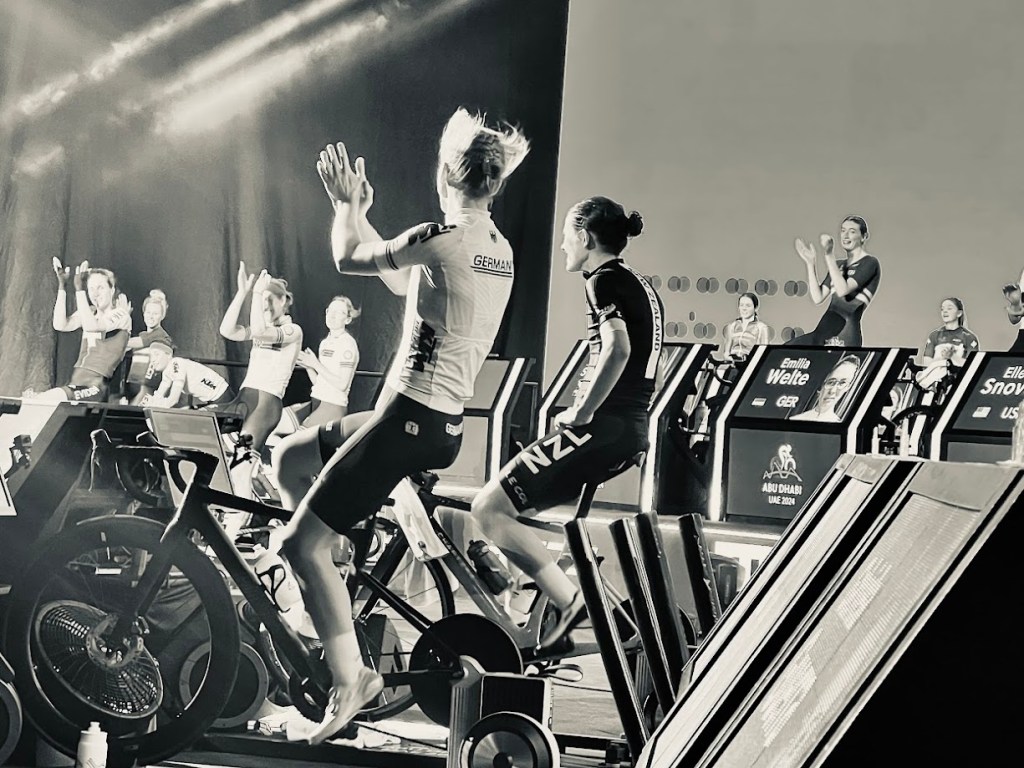
The UCI has finalized its national federation quotas and unveiled early competition details for the 2025 UCI Cycling Esports World Championships, confirming a familiar rider allocation structure and a few notable tweaks to its newest world title event. The fifth edition of the championships and second live event final will take place on November 15th in Abu Dhabi, UAE, at the Space 42 Arena under the ongoing partnership between the UCI and MyWhoosh.
The Qualification Picture: Weighted History
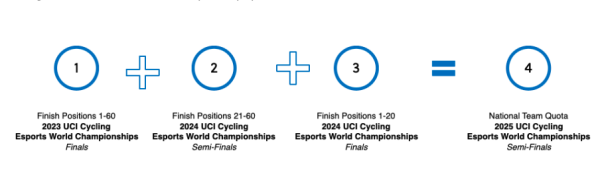
The national quotas for the 2025 semi-finals continue to reward federations with historical engagement and recent success. The UCI’s qualification system draws on performances from the previous two editions, allocating points to nations based on finishing positions in 2023 and 2024.
Using the UCI’s established road world championship points tables, the top 60 finishers from the 2023 finals, the top 20 from the 2024 finals, and positions 21-60 from the 2024 semi-finals contributed to each federation’s cumulative total.
This rolling two-year scoring system produced five quota groupings:
- Group A (10 riders per gender): Top 4 nations by points.
- Group B (7 riders): Next 4 nations.
- Group C (5 riders): Following 4 nations.
- Group D (4 riders): Next 4 nations.
- Group E (3 riders): Remaining nations with participation.
Importantly, any federation participating in prior years automatically secures a minimum quota, ensuring continued global representation.
Who Gets to Start: The Leaders and the Chasers
On the men’s side, Germany leads the rankings with 2,480 points, followed by Denmark (2,280), Belgium (1,625), and the USA (895), each earning the full 10-rider allotment. In the women’s field, Great Britain tops the table with 2,135 points, ahead of the USA (1,880), Sweden (1,350), and the Netherlands (1,050), all also receiving maximum quotas.
The next tiers feature a mix of traditional powers and nations leaning heavily into esports. Australia, Finland, Norway, South Africa, New Zealand, Switzerland, and Brazil sit in Group B with 7 riders apiece, while nations like Poland, Canada, China, Ireland, and Japan fill out the smaller allocations. Emerging programs such as Argentina, Turkey, the Philippines, and others underscore the discipline’s widening global reach.
Spain remains entirely absent from the quota allocations, an increasingly curious omission for a country that has long been a mainstay of road cycling’s elite ranks but remains disengaged from esports participation or acknowledgment of their athletes following the open qualification pathway.
Automatic Bids for Defending Champions
The defending world champions secure automatic places in the semi-finals independent of their nation’s quota. Germany’s Jason Osborne, who reclaimed the men’s title in 2024 after previously winning in 2020, will lead the men’s field.
In the women’s event, New Zealand’s Mary Kate McCarthy will return to defend her rainbow stripes after her 2024 triumph. Both champions will bypass qualification and receive direct entries to the semi-final on October 3rd, 2025.
Qualification Opens to All — National and Public Routes
The path to Abu Dhabi features both federation-controlled and open-entry opportunities. Roughly 70% of 150 semi-final start spots will come through national federations, which may designate their representatives through internal selection or qualifying events.
The remaining 30% will come from public qualifiers organized directly by MyWhoosh, offering individual riders a chance to earn their place on merit through open competition.
The qualifying window will begin shortly and run through October, with specific dates for federation and public qualifiers still to be confirmed.
Semi-Finals and Finals: Three Races, One Champion
The October 3rd semi-finals and the November 15th finals will follow an identical three-stage format, blending pure speed, tactical racing, and climbing attrition into a format designed to showcase versatility and deliver live entertainment. (The details below are preliminary and subject to change.)
- Sprinter’s Paradise: Eight laps of a 1.5 km circuit, with points awarded after each lap’s sprint. The final lap offers a larger points bonus, placing a premium on positioning, consistency, and recovery across repeated sprints.
- Punchers’ Playground: A 12 km course filled with short, steep climbs and sprint segments, with two KOMs and two intermediate sprints, rewarding riders capable of repeated explosive efforts. The final sprint carries the highest point value.
- Last Rider Standing!: A 7.2 km climb with 554 meters of elevation gain, contested as a survival-style elimination race. Riders earn points at each checkpoint based on their placement and survival time. The final rider standing secures maximum points.
For both the semi-finals and finals, total points across all three stages will determine final standings. In the semi-finals, the top 20 men and 20 women on points will advance to Abu Dhabi, joining any wild card entries awarded by the UCI
A Compressed Admin and Pre-Verification Window
Federations must accept their quota allocations and submit their rider selections by August 31st. Those failing to meet the deadline may forfeit unused spots, which the UCI reserves the right to redistribute.
As with last year, all athletes must complete MyWhoosh’s full performance verification process, including dual recording and equipment calibration, be level 10 or above, and have competed in a MyWhoosh Premier racing event in the past 6 months, before being cleared to race. Consult the MyWhoosh Cycling Esports Rules and Regulations for hardware and performance verification requirements.
Year Two for MyWhoosh — Progress Made, But Work Remains
The 2025 World Championships mark a meaningful step forward in the evolution of cycling esports under MyWhoosh’s second year in stewardship. The live finals, standardized equipment, expanded federation participation, and public qualification pathways reflect a discipline maturing beyond its experimental phase.
While the racing product inside the Space 42 Arena continues to evolve, there’s still room for the broadcast experience to better capture the full energy and drama of the competition.
Bridging the gap between the intensity of live competition and the remote viewer remains one of the sport’s most pressing challenges.
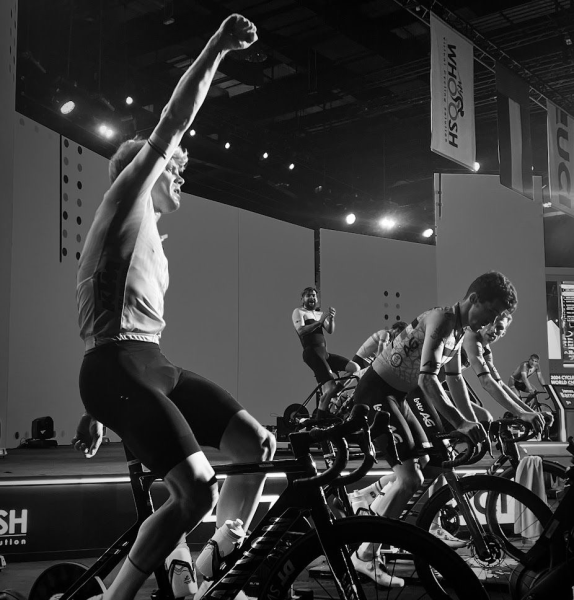
The racing has real human drama—athletes on stage, fighting for rainbow jerseys—but much of that drama struggles to translate through current production approaches fully.
Creating a more immersive, engaging broadcast product will be essential if cycling esports is to captivate a broader audience and cement its place alongside cycling’s more established disciplines.
For now, the table is set. The world’s best virtual cyclists will battle through national qualifiers, public heats, and grueling semi-finals before converging on Abu Dhabi’s Space 42 Arena in November. The fifth edition of cycling’s youngest world championship is taking shape—and as always, it’s part sporting spectacle, part technical experiment, and part glimpse into where the sport may be headed.
Semi-retired after more than 20 years as the owner and director of a private Orthopedic Physical Therapy practice, Chris now enjoys the freedom to dedicate himself to his passions—virtual cycling and writing.
Driven to give back to the sport that has enriched his life with countless experiences and relationships, he founded a non-profit organization, TheDIRTDadFund. In the summer of 2022, he rode 3,900 miles from San Francisco to his “Gain Cave” on Long Island, New York, raising support for his charity.
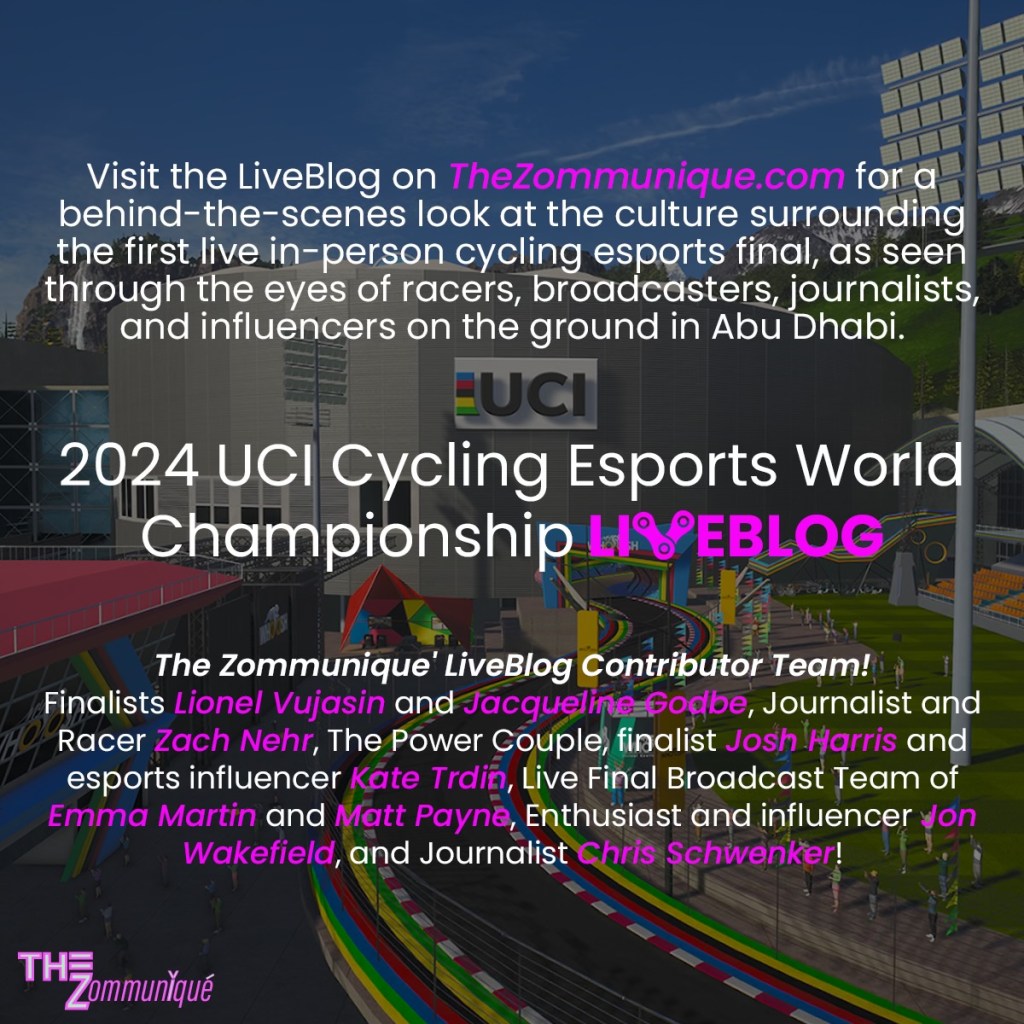
His passion for cycling shines through in his writing, which has been featured in prominent publications like Cycling Weekly, Cycling News, road.cc, Zwift Insider, Endurance.biz, and Bicycling. In 2024, he was on-site in Abu Dhabi, covering the first live, in-person UCI Cycling Esports World Championship.
His contributions to cycling esports have not gone unnoticed, with his work cited in multiple research papers exploring this evolving discipline. He sits alongside esteemed esports scientists as a member of the Virtual Sports Research Network and contributes to groundbreaking research exploring the new frontier of virtual physical sport. Chris co-hosts The Virtual Velo Podcast, too.