
By FemmeCycle Collab member Jenn Moroz
FCC’s Jenn Moroz Explores Multi-Platform Virtual Racing to give her first-hand experience on what Works and What Doesn’t
What did she like and how could it be better? You’ll get the first look!
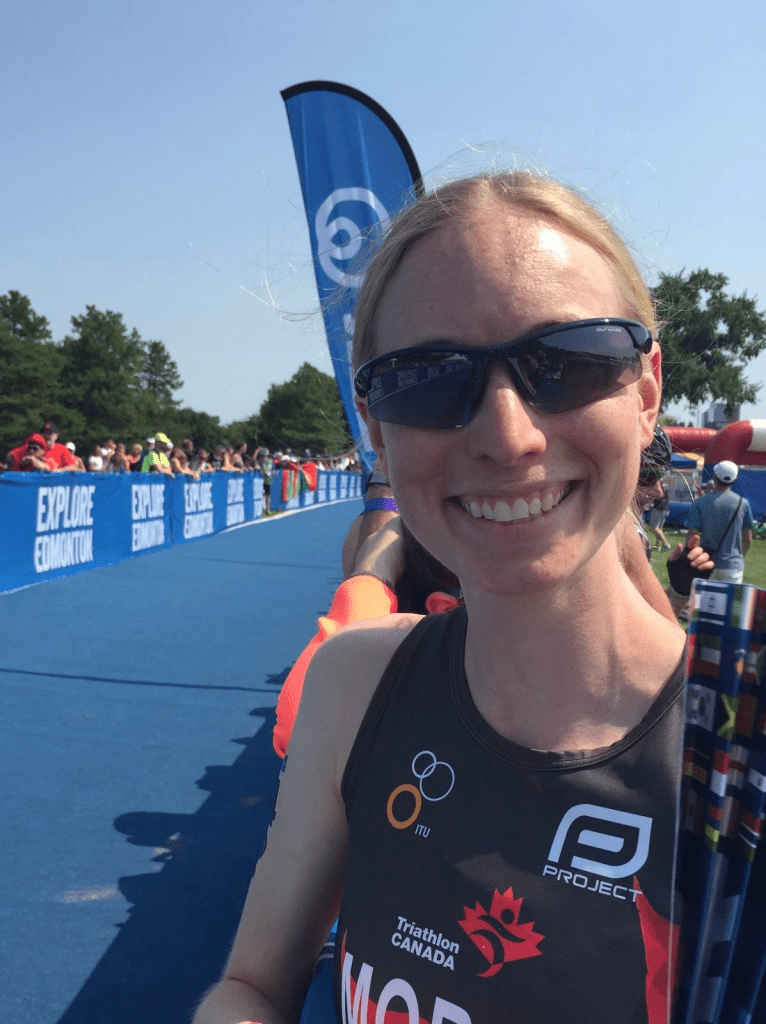

The Olympic Games inspire athletes to think about their performances and wonder what more they have inside them. How far can we push ourselves into what some call impossible?
The popular Flamme Rouge Racing (FRR) series, organized by Rich Vale since January 2022, is a series that looks insane on paper. Yet, we manage to get through it together–while bonding with fellow competitors and teammates who encourage us to keep riding further than we can comprehend.
Inspired by the Paris Olympics in July 2024, Rich dreamed up a new series: the Mytikas Games. These games would not only challenge racers to explore their range and ability to perform on flat, hilly, and gravel terrain but also to adapt to different environments in three different cycling esports platforms: Zwift, TrainingPeaks Virtual, and MyWhoosh (from here on out, referred to as the “arenas”).
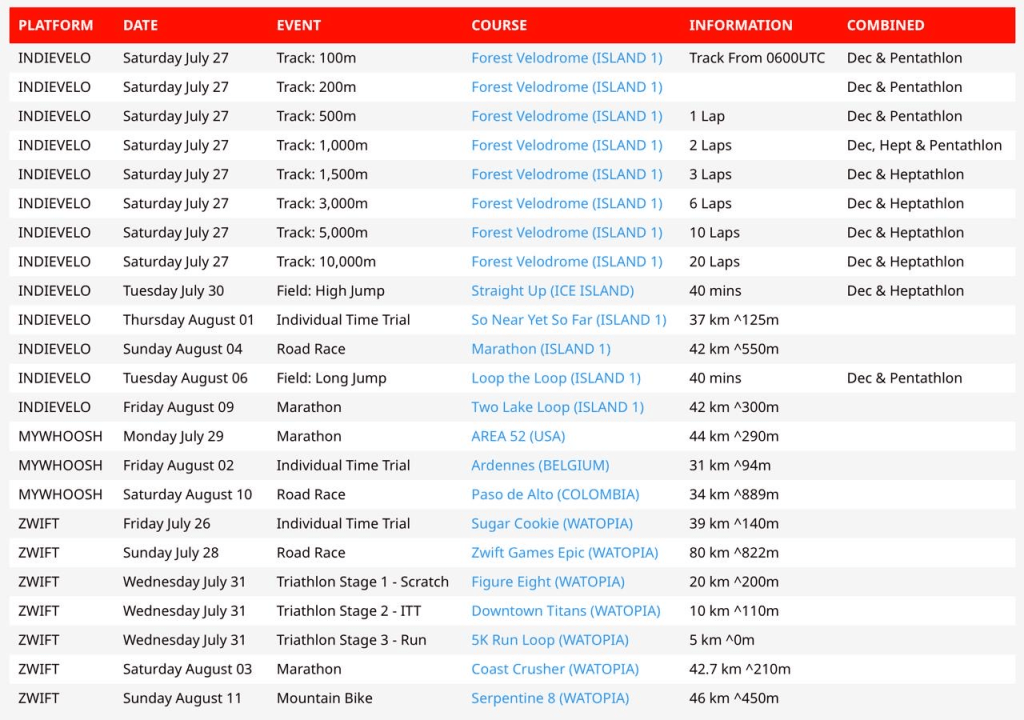
The Games host fifteen cycling and running events. Some races, like the cycling road race, the cycling ITT, and the marathon, were hosted on all three platforms, allowing riders to choose the arena where they would perform best. At the same time, others were hosted in one arena only.
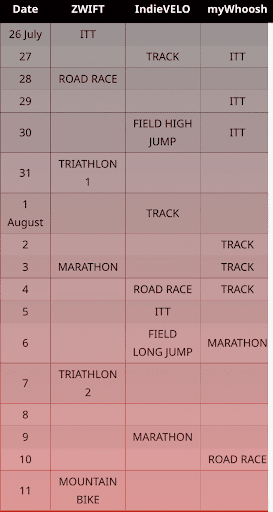
The mountain bike and triathlon were contested in Zwift, while TrainingPeaks Virtual hosted all track and field events. Riders were split into ten “heat classes” based on FTP and weight (heat class was unique to each arena) and were divided by gender. Racers earned medals for their country in every event contested by gender and heat class.
Zwift: ITT, Triathlon, Mountain bike
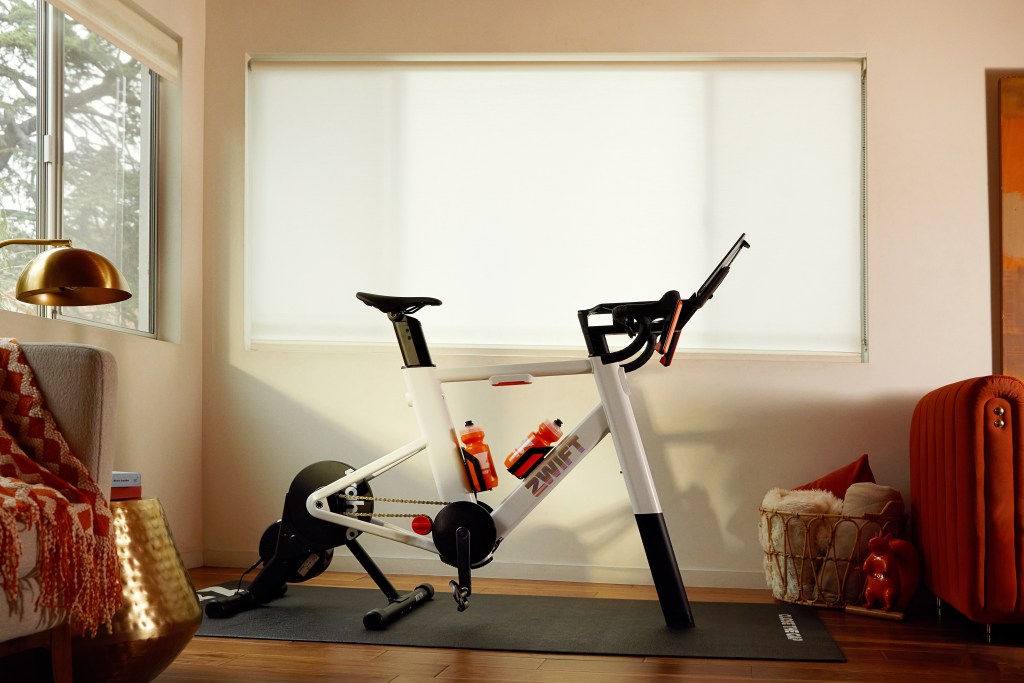
Zwift is the arena that felt like competing on home roads. Most riders are familiar with the drafting dynamics, have accumulated many racing setups (bikes and wheels), and know the courses. All Zwift races split the pens into men’s only (A) and women-only (B) competitions and forced all athletes to race on the Zwift bikes for fairness. Racers were encouraged to select their wheels before entering the pen.
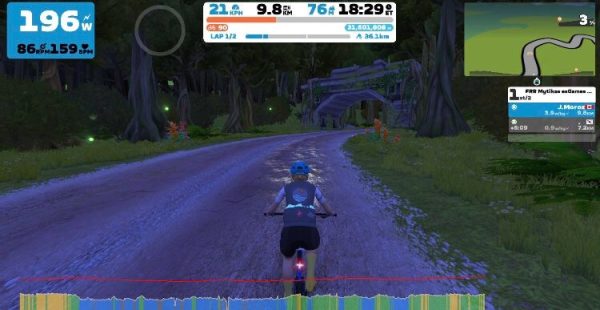
The ITT was on Sugar Cookie with drafting and power ups turned off. The course was primarily flat, with a long descent through the jungle during the lead-in and at the end of the loop. Riders also had a 4-5 min climb up the approach to the Epic K/QOM. With just the competitor vs. the clock, riders must be strategic in how they spend their watts.

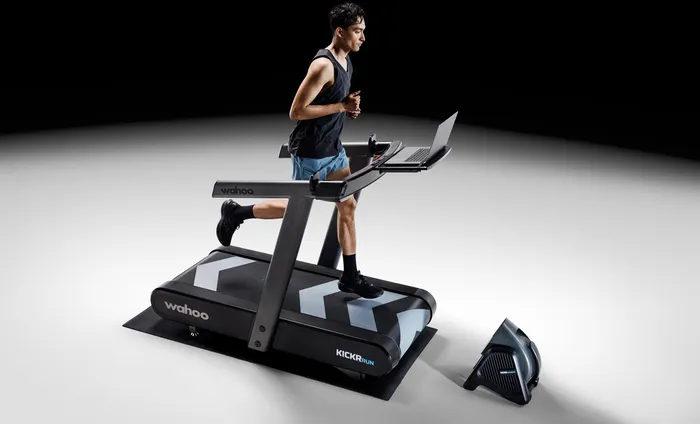
The triathlon was a three-part race: a 20 km scratch race on Sugar Cookie, a flat 10 km ITT around the desert, and a 5 km run. Runners could run outdoors and send in a GPS file if they didn’t have a treadmill or run pod compatible with Zwift. The triathlon was scored by adding the times of all three individual legs. It was an incredibly fun event to race as it simulated riding in the pack, getting into a breakaway late on the bike, and then running to victory!

The mountain bike was a scratch race over two complete laps of the Serpentine. All racers were assigned to ride the Zwift mountain bike but had the option to pre-select faster wheels. With long and short climbs along the route, there were plenty of opportunities to stage an attack for dynamic and fun racing.
Zwift’s Best Features
- Many riders race primarily on Zwift. We are familiar with the pack dynamics and light riders can stay in large groups on the flats.
- Zwift has a large community of racers. Several events have large groups. Interacting with one another through the Companion App and in-game messaging is easy.
- Power ups change the racing dynamics, which encourages strategic planning and experience on when to use them.
- There is ample information regarding bike setup, pack dynamics, and race courses. Many refer to Zwift Insider articles as our go-to for need-to-know content. Other sources are live YouTube streams from fellow Zwifters and word-of-mouth from our teammates.
- Plenty of race series to compete in. The calendar fills up with exciting new series catering to different riders each year. Flamme Rouge racing (FFR), the Chasing Race series, and the Zwift Racing League (ZRL) are favorites. In 2024, organizers are introducing a women’s only racing series under the FemmeCycle Collab (FCC). Join the Zwift Companion team and our discord. https://discord.gg/EDcxMFTSt6
What You Need to Know About Zwift
- Drafting dynamics: while light riders can stay in packs on flat routes, they must be careful when approaching descents. Push up to the middle of the group before going downhill.
- Pacer bots are a great opportunity to practice drafting and get a feel for how hard you need to push with different-sized groups.
TrainingPeaks Virtual: Track and Field, Cycling road race, and the Marathon
TrainingPeaks Virtual played host to all track and field events, as well as the cycling road race, the cycling ITT, and the marathon. You never need to worry about small fields in TrainingPeaks Virtual, as this platform adds bots with abilities similar to registered riders to the pens. You don’t know who is human or a bot, but I was very happy to have more wheels to chase!
TrainingPeaks Virtual operates on the premise that everyone competes to the best of their abilities, with honesty and integrity. Before entering the race, we had to confirm that our weight was accurate and were encouraged to dual record if we could (including a reminder to calibrate equipment before joining the race). The trainer’s realism was 100% for all events in the Mytikas Games.
Track and Field Competitions
The track events covered eight distances of increasing length within the hour. All races were on the velodrome, and drafting was disabled. The gaps between races were long enough to do a short spin to flush out the legs and catch your breath from the previous effort. However, you were still racing hard for an hour, and accumulated fatigue was something you needed to account for during the longer events.
The track and field events were scored individually as stand-alone races based on finish time and also grouped with the long jump and high jump for the combined event’s competitions (pentathlon, heptathlon, and decathlon). The pentathlon emphasized shorter track events, the heptathlon emphasized longer ones and the decathlon took all ten. Savvy racers had to strategically plan which events to push the hardest to maximize their combined events ranking.
The high and long jumps were in an ITT format. The high jump sent us straight up a mountain for 40 minutes to see how far we could go. Conversely, the long jump was on a flatter course to see how far we could travel in 40 min. Medals went to those who climbed the highest or rode the furthest in each heat class.
Going the Distance: Cycling Road Race and the Marathon
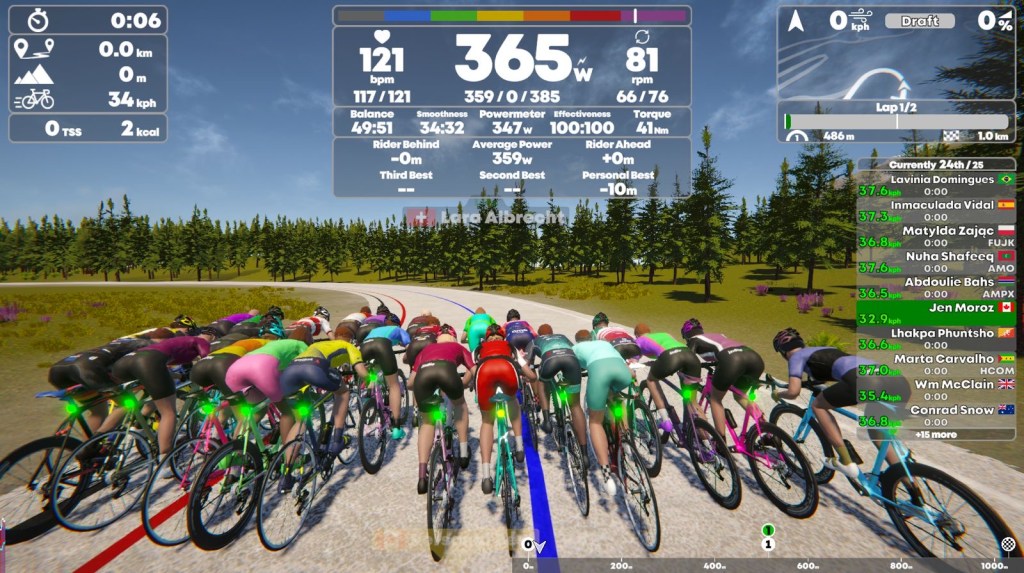
The cycling road race and marathon were points races with nine opportunities to add to your tally. It was a mass start with all heat classes and genders combined. The pack dynamics in TrainingPeaks Virtual feels more true to outdoor riding. While I could stay in the draft on the flatter sections, I often found myself at the back of the group. It’s worth pushing those extra few watts to work your way towards the front and protect your position.
The cycling road race was great for a lighter rider as we had a 9 Km mountain to climb early into the race. I got into the top 10 through the early points banners and then had to ride scared after summiting the mountain and pushing as hard as I could down and along the flats to the finish.
The marathon was two laps of a flatter course with three short climbs each lap. The pack broke up on each climb, so it was important to pay attention to riders behind you to catch their draft as they came by. The addition of the bots are a welcomed addition, as there were more small groups to ride with, regardless of your ability.
Best Features of TrainingPeaks Virtual
- Rider speed appears in the sidebar. You can use this information to know when there is an attack or if you need to ramp up to catch the draft of a rider coming up on you. It’s also useful on climbs to know when the gradient is about to change as it’s reflected in the speed of riders ahead.
- Points races tell you how far away the next prime is and display the course elevation on the screen. This information feels like a race radio and lets you plan your attack well before the prime!
- Bots are added to the pen to increase the field size. These bots are simulated based on the ability of riders in the pen. It’s great for motivation and pushing you to the correct level. You don’t know who is a bot or who is real. Have fun and just race!
- TrainingPeaks Virtual is upfront about fair competition. I like that you can connect your trainer and a secondary power meter in the game. I could see the data from both power sources in the field events (ITT style). Points and elimination-style races showed data from the primary power source in the default setup. The game reminds you to use an accurate weight and properly functioning equipment (calibration option available here) before entering the event.
- TrainingPeaks Virtual allows you to customize data on the screen. I kept the default settings for this series as I’m new to the platform and still figuring out what is most useful to me as a racer.
- More race formats are available. TrainingPeaks Virtual offers a huge variety of race styles to choose from. Everything from short, intense efforts on the velodrome, ITT, points races, elimination events, and team time trials.

Things You Need to Know About TrainingPeaks Virtual
- The pen is open from 1-25 min before the start of a race. Make sure you join early. You can’t join at the last minute!
- Wind! TrainingPeaks Virtual does a good job simulating outdoor riding, forcing riders to adapt their strategy based on the wind. While the wind was generally 6-8 Km/h, I noticed the trainer resistance change when riding with a head or tailwind. The HUD displayed wind strength and direction.
- Points and elimination races have a neutral start. They have a pace bot leading the field through the first km. Ride easy until you get instructions to go! Otherwise, you will yo-yo through the group.
MyWhoosh: Road race, ITT, and Marathon
MyWhoosh hosted the marathon, road ITT, and road race. They have a velodrome available for track racing, and there will likely be a second arena to offer these events in future games. Like TrainingPeaks Virtual, the pens were mixed gender to increase the field size and were available for several time zones. Due to scheduling, I could not make the races on MyWoosh, but my teammate did all three. He said that the number of participants was larger than in the Zwift races but smaller than in TrainingPeaks Virtual (due in part to the addition of bots) and that they were primarily men.

The road race was on a hilly route that started flat, then pitched upwards just past the 8.0 Km mark. It would be an ideal course for a lightweight climber, as you could sit in the draft to that point, and then push your watts all the way up to the finish. The first (of two) climbs were steeper, creating separation within the pack.
The ITT and marathon courses were flatter and favored the riders who could hold higher watts. Each featured a couple of short climbs to give the primary ITT muscles a short break. All three events were scratch races, with intermediate points disabled for the event (though you could use the segments to mentally break up the race!).

MyWhoosh’s Distinguishing Features
- Ability to connect two power sources in the game. It may differ between races, where some require two power sources, while others only allow you to connect one. All events in the Mytikas Games required only one power source.
- MyWhoosh has multiple race formats, including ITT, points races, climbing challenges, crit races, and elimination-style events.
- The distance remaining in a segment shows up in the display during points races.
- Free ride with others with a My Bunch ride. These are similar to a group ride or pace partner in Zwift.
- Includes weekly competitive Sunday Race Club races. Riders must complete a power passport, have a dual power recording, and submit a weigh-in video. Trainer realism can be set anywhere between 50-100% for these races.
Things You Need to Know About MyWhoosh
- The draft is 10 m long and feels less sticky compared to Zwift. Lighter riders need to stay focused on their position.
- The HUD is similar to Zwift. The rider list is on the right-hand side of the screen and shows nearby rider’s wkg, distance in race, and time ahead/behind you. There is a graphic that shows which power zone you are riding in. On the left, they show a mini-map with distance completed, meters climbed, current and average speeds, and the amount of KJ burned (for those of you training by KJ workload).
- For some events in MyWhoosh, bots join the pen to increase the field size.


Reflections on the Games
Overall, the Mytikas Games was a fun competition to participate in. Participation numbers were low since it was the first series using three different arenas. However, I see the Games growing in popularity as more people get familiar with TrainingPeaks Virtual and MyWhoosh. This race series was a lot of fun, and I encourage more women to participate in the next Games.
The scoring is set up so that each event is a stand-alone. You earn medals for the events you do, with no penalty for missing others. TrainingPeaks Virtual and MyWhoosh offer more opportunities to find races that you enjoy. All three platforms are similar enough that you can familiarize yourself with the game with a couple of rides but also offer unique features to keep riding fresh.
Author Bio—Jenn Moroz
Jenn, a former runner and triathlete, began using Zwift in 2020 as a way to cross-train. However, her focus quickly shifted to competitive e-racing after joining On the Rivet (OTR) Racing. She now serves as the women’s team manager for OTR and leads several club rides, including the Sunday Night Tempo, Snap-Crackle-Pop, and the Monday Recon Ride.
When she’s not racing through Zwift’s virtual worlds, Jenn loves traveling to races across North America with her husband, Winston.






Amazing work J-Mo
Great to see this review, definitely saw you throughout the ‘Games’…. 3 platforms, sharing in general the same riders but at a time when weather for the majority said ‘be outside’ … I loved the Triathlon event (ok – no swim) and it coincided with a really hot day to run outside (and I’m not a runner) but I just wanted to ‘try’ something different and I think that was the whole point of this Series – utilising the platforms with a different purpose and with riders who are not only engaged but a pleasure to be virtually aside.
The biggest take away from the Series was ‘what makes the series’ …the answer is easy… the community of riders who join make s Series, the discussion, banter, the help and support they give each other and the bond that forms.
Achieving this is the difficult part for any organiser, even more so when asking riders to try new platforms with new tech challenges plus other potential barriers… however – we knew this from the outset and yet it was right to ‘try’ … we were the first , we may not be the second but FRR will persist with being innovative – as our latest event has just proved…so keep an eye out for more on FRR Super 6ix Racing… summer 2025!
In the right hands so much more can be done encourage platform members to expand their multi-platform engagement and we at FRR are certainly open to discussions based on our organising experiences.
Well said, Richard! You deserve acknowledgment for implementing the concept and breaking ground on the multi-platform landscape. I’m excited for the future!