
Clearly defined expectations for competition in cycling esports will eliminate confusion, enhance accessibility, and promote inclusion.
Next December, the inaugural Enhanced Games, or “The Steroid Olympics,” if you like, aims to showcase athletes across the world doped to the gills with whatever they deem beneficial and acceptable within their skewed sensibilities.
The Enhanced Games organizers claim that “Sports can be safer without drug testing.” Meanwhile, Reuters reports that the games will “push the limits of humanity.” Why not, the organizers say, when “44% of the athletes already use performance enhancements.”
It promises to disrupt the ethos of the “old, slow, hypocritical, corrupt, and dysfunctional” Olympics with enhanced world records and super-human feats of speed, strength, and endurance because, quite frankly, they are.
Whether you agree or disagree with the ethics and health-related ramifications (this author certainly disagrees), there’s one philosophical truth that all the enhanced athletes share beyond their overworked livers, undersized reproductive glands, and dulled sensitivities to side-eyed sneers.
They all know what they’re getting themselves into. The expectations are clearly defined. Many believe cycling esports should take a similar approach.
indieVelo’s Expectations for Competition Are Clear
Cycling esports platform indieVelo developer and former Zwift Cycling Esports Chairperson Dr. George Gilbert said it well when outlining plans to categorize event types accordingly.
“Generally speaking, there’s a time and place for everything. What really matters is whether you meet your expectations,” says Gilbert.
indieVelo designates events based on results tracking, performance verification standards, and competitive nature.
Group rides are strictly non-competitive, don’t have results, and have minimal performance verification.
“For example,” explains Gilbert,” in online cycling, an event presented as a high-level competitive race but has a significant number of people cheating in it will cause disappointment, but if you present precisely the same event as being just a training ride with no results, it matters far less what anyone else is doing.”
The implication is that there is no reasonable expectation of equipment accuracy, hardware standards, or pedaling style when riding just for fun or training purposes.
Unranked events on indieVelo are like unstructured group rides or fun races with nothing on the line but bragging rights with only baseline automated performance verification checks.
“Equally, it’s reasonable to expect everyone to prepare in advance for entering a competitive race, such as ensuring that they calibrate their trainer correctly and that their equipment is working properly,” Gilbert says.
Competitive races on indieVelo have results that count toward an athlete’s in-game ranking and a full suite of performance verification checks. Riders that fail real-time verification are flagged and automatically removed before negatively impacting the race experience. Organizers can add further equipment restrictions to ensure a level playing field.
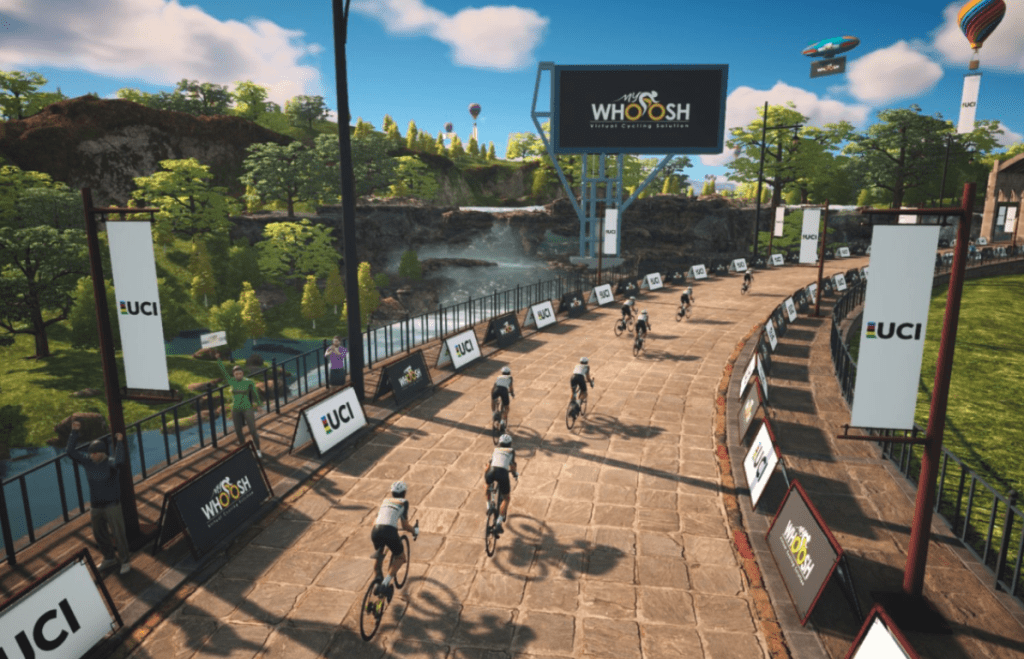
The platform clearly defines the expectations, and there is no compromise. The same is true for the virtual venue MyWhoosh.
MyWhoosh Sets Strict Standards For Events That Offer Prize Money
Riders who compete in the platform’s flagship Sunday Race Club must complete extensive pre-verification to earn a share of the $284,000 monthly prize pool.
Riders must video-record themselves performing the MyWhoosh Power Passport Test, a series of performance metrics over varied durations. The video must include a height and equipment assessment at the start of the test, followed by a weigh-in after its conclusion. It has to be continuous, covering all requirements in one take. MyWhoosh also recently implemented limited real-time performance verification.
MyWhoosh pays out across four categories for men and women, including a team competition. Performance verification is not only about elite athletes.
In a recent interview for the Virtual Velo Podcast, Matt Smithson, MyWhoosh’s Race Control and Events Manager, said, “We have a BI and AI team of twelve people building the performance verification and other technical aspects.”
Both platforms have additional systematic anti-cheating measures in place, such as built-in dual recording, which help establish clear expectations.
The concept is nothing new to online multiplayer games, whether called “Ranked vs. Unranked” or “Competition vs. Non-Competition” mode.
Most Multi-Player Online Games Have Ranked and Unranked Modes
Ranked multiplayer video games have highly competitive play, where participants are evaluated and assigned a rank based on their performance. Much like indieVelo, the aim is to climb the ranks, which reflects one’s skill and progress.
Examples include “League of Legends,” “Overwatch,” and “Rainbow Six Siege,” where players engage in seasonal or ongoing ranked matches to improve their standings.
Conversely, unranked multiplayer games provide a casual gaming experience without the pressure of a ranking system. Players can experiment with strategies, play more relaxedly, or enjoy the game with friends of varied skill levels. Theoretically, without judgment or fear of negatively impacting the experience for more highly-skilled players and facing the “not-so-nice” consequences.
Unranked modes are available in many games that also offer ranked play, such as “Dota 2,” “Counter-Strike: Global Offensive,” and “Call of Duty.” These modes allow players to focus on enjoyment and practice without worrying about their rank.
In essence, ranked games cater to those seeking a structured, competitive experience, while unranked games are ideal for players looking for a more relaxed and less competitive environment. In both cases, players know the expectations upfront, leaving no room for confusion.
Unclear Expectations Cause Confusion and Disappointment
Problems arise when poorly defined expectations cause ambiguity, breed ill-will, promote self-policing, and result in a culture of cheating that challenges the development of cycling esports.
When you join your friends for the season’s first cafe ride, ask one of your traditionalist pals, “What’s the first thing that comes to mind when you mention Zwift racing?” The response is almost always, “They’re all cheaters.” Clearly, this perception is problematic.
Take, for example, the following post in the Zwift Riders group, which was made on the day of this writing and found after a brief cursory search. A Zwift user and group member since 2021 stated the following.
“The last couple of big Zwift rides I’ve been on (Zwift Games and The Zwift Big Spin) have had a rider off the front doing ridiculously high steady watts, and yesterday, this lead rider was doing 0 cadence. Surely, Zwift can kick these obvious bots from the rides. All they do is cause negative chat during the ride.”
The ensuing comments range from “I’m just here to get some exercise” to “Turn off the chat.” One pointed out the difference between the Zwift Games, a sanctioned competitive event, and The Zwift Big Spin, a group ride.
Group Rides vs. Races—It Should Be Easy to Tell
The confusion is understandable. The event description on the website and the companion app doesn’t mention “Group Ride” or “Non-Competitive.” Like real-world competitions, finishers get prizes, and results are on ZwiftPower, alongside races and other competitive events, with designated categories.
The official Zwift description reads, “We couldn’t stop with just tons of great prizes, so we stacked each stage with plenty of PowerUps too, including improved drafting, cloaking, burrito, and more! Think of PowerUps as little tricks to help you break away — or catch up — with the push of a button on Zwift Play, a keyboard, or the Companion app.”
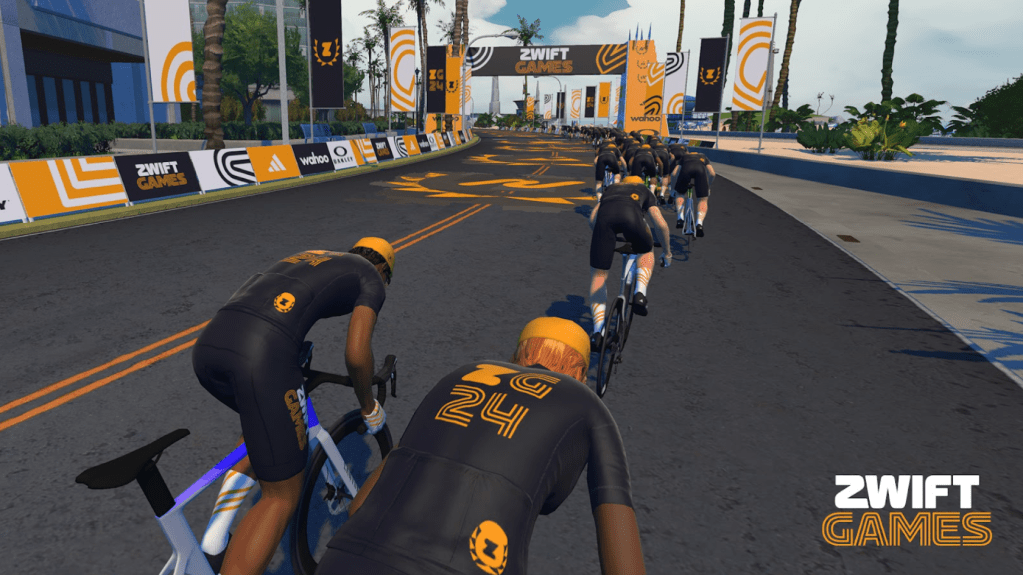
The Zwift Games offers prizes, has PowerUps, and appears in ZwiftPower with categories. The event description mentions that it’s a competitive race.
The conversation spilled over to the Zwift Forums post by employee Amanda F announcing The Big Spin. Another user shared similar sentiments and summed up the issue well when commenting below the event description.
“One of the most common questions asked by people, especially new Zwifters, in event start pens is “Is this a ride or a race?” The most common answer they’ll get in the chat is “It’s always a race,” which can be off-putting for newcomers trying their first events.”
He went on to ask the question that lies at the issue’s crux.
“Can you please make sure the event description answers this question to make it clear people can ride it how they want? Without Zwift being explicit on this, people will make up their own minds, and we’re likely to get people grumbling about other people going too fast or using coffee stops. Please can Zwift add some similar words to the description to make sure it’s clear everyone can ride as fast or slow as they want?”
Other users posted more examples, including one from an astute racer who said, “It’s funny that the same week indieVelo introduced real-time performance verification, race attendance dropped. They all returned to Zwift, where it’s perfectly fine to cheat.” Sources indicate the veracity of the comment and the impact of clearly defined expectations.
It Isn’t All Fun and Games
The findings of confusion, unclear expectations, and feeling annoyed or frustrated are consistent with this October 2023 study, Perceptions of Cheating and Doping in E-Cycling.
Of the 1,467 participants who responded to the virtual cycling-specific survey, a majority, 44% of the participants reported experiencing cheating during a virtual cycling competition (40% did not, and 4% didn’t race). 51% reported feeling angry or annoyed by the perception of experiencing cheating.
Would the perception change if the expectations were known up front?
Where Can the Highly Competitive Turn?
For some users, it is just a fun way to get a good workout, and that’s okay if everyone playing feels the same way. However, a large user base is looking for more than a fun workout and seeks competition and a level playing field.
Where can they go where the expectations are defined and achievable?
“Despite the occasional noise from a minority within the Zwift community, deliberate cheating on the platform is indeed quite uncommon,” says WTRL’s Martin Carew, the organizer of the Zwift Racing League (ZRL).
According to Zwift, the platform experienced a 10-20% year-over-year increase in monthly competitive users in 2022/23. Notably, one-third of all users participated in at least one race—an approximate 50 percent increase.
The company’s premier community series, the ZRL, saw a 56% year-on-year growth in racers and a record number of teams and divisions during the 2023/24 season.
Zwift leaves performance verification and governance of community-level events in the hands of the organizers, such as Carew, who says, “To my awareness, I am the only one developing (performance verification) outside what is available through Zwift or ZwiftPower. Hours of testing, developing, and building help WTRL on this front as, over the years, I have (and continue) to automate these things.”
Carew’s anti-cheating algorithms are only as good as the tools they have to work with and the mandate to balance accessibility and authenticity.
In Episode 34 of the Virtual Velo Podcast, Martin explains his built-in anti-cheating system, the challenge of finding the perfect balance between credibility and inclusivity, and the limitations he faces.
The Fair E-Racing Alliance
According to FERA’s investigation, up to 40 percent of the racers in some B-D divisions of the ZRL are using hardware that is inherently inaccurate or unable to be appropriately calibrated, says one of their members
A group of community cycling teams (now ~35) dedicated to fair racing on Zwift formed the Fair E-Racing Alliance (FERA) in 2022 under the leadership of Roman “Edelhelfer” Kuhn to fill the void left by the lack of oversight. The alliance’s mission is to develop essential tools enabling participating teams and their leaders to recognize anomalies in data amongst their riders rather than denouncing riders from opposing teams.
They’re not referring to smart trainers and smart bikes. Instead, spin bikes that grossly overestimate power based purely on cadence and speed, among other devices. They don’t fall under the ZPower provision in the ZRL rules, which acts as a deterrent by affecting a team’s points.
Or the app with over 45,000 downloads on iOS and Android that converts your heart rate to power and can spoof any trainer ant+ ID. The app’s website cites Zwift in its “How it works” section.
FERA members know it works because they’ve tested it, and it wasn’t detected. Sources indicate thousands of racers also know it works because they use it, and it isn’t detected.
Expectation vs. Accessibility—What’s the Debate?
Zwift staffer David P made the following statement in the forum in March 2023 after FERA flagged a similar issue.
“We are working on a more broad list of forbidden devices, but there are a few difficulties. The border between what can be considered accurate and not accurate is not so black and white. Perhaps it is for elite events, but for a more inclusive community racing platform, it can be debatable.”
Many users will struggle to find a real-world racing example where the basic equipment rules vary between levels.
Accessibility to racing is essential for revenue in a subscriber-based model. Alienating or upsetting 40 percent of the racers could result in the loss of a handsome sum—a difficult conversation to have with investors. It makes business sense to look the other way and instruct your contractors to do the same.
However, by clearly defining expectations and setting standards, everybody has a time and place. Creating a non-competitive environment will decrease anxiety and intimidation, which in turn enhances accessibility and promotes inclusion.
On the other hand, establishing a range of competition categories with explicit hardware restrictions and effective methods to prevent non-compliant riders from joining restricted events will enhance transparency and build trust within the community.
We all can’t be elite racers, but for some of us, that doesn’t mean we take competition any less seriously. Do we deserve a level playing field? Even the athletes competing in the Enhanced Games know what to expect.
Semi-retired after more than 20 years as the owner and director of a private Orthopedic Physical Therapy practice, Chris now enjoys the freedom to dedicate himself to his passions—virtual cycling and writing.
Driven to give back to the sport that has enriched his life with countless experiences and relationships, he founded a non-profit organization, TheDIRTDadFund. In the summer of 2022, he rode 3,900 miles from San Francisco to his “Gain Cave” on Long Island, New York, raising support for his charity.
His passion for cycling shines through in his writing, which has been featured in prominent publications like Cycling Weekly, Cycling News, road.cc, Zwift Insider, Endurance.biz, and Bicycling. In 2024, he was on-site in Abu Dhabi, covering the first live, in-person UCI Cycling Esports World Championship.
His contributions to cycling esports have not gone unnoticed, with his work cited in multiple research papers exploring this evolving discipline. He sits alongside esteemed esports scientists as a member of the Virtual Sports Research Network and contributes to groundbreaking research exploring the new frontier of virtual physical sport. Chris co-hosts The Virtual Velo Podcast, too.

Agree with what is here. I think Zwift is trying to do everything for everyone and for the general population that is cool and they are willing to pay $20/month. However, the dedicated racers really feel like Zwift isn’t doing enough to improve that experience and so the price increase feels silly because their experience has not been materially changed by Zwift itself. Most racing improvements have come from community organizers or projects (WTRL, ZR.app, FRR, Chasing and Sauce) so racers are asking what is the extra money going toward. Most will stay (including me) because it is where our friends are and I can afford it. The racers are a significant minority so Zwift can afford to lose them but they are the die hards and have the potential to be great brand ambassadors. I think that that Zwift spinning of a racing mode would serve them well and I would pay an extra $5 on top of it for that (if done by people trust like the IV folks who have proven themselves)
Insightful comment, Jeff! Thanks for sharing!