
Smart Trainer Standardization is Only Months Away, according to the UCI

A protocol to certify hardware accuracy and wireless communication is one step closer to an International Calendar and Ranking System for cycling esports.

Author’s Note: The information found in this report is from direct one-on-one interviews with UCI and MyWhoosh representatives during a recent press tour, culminating in a press conference on January 25, 2024, at the Abu Dhabi Cycling Club, Al Hudayriyat Island, UAE.

As first reported in Cycling News on February 8, 2024!

The convenience and accessibility that make cycling esports attractive to athletes and enthusiasts raise a critical question. As we expand the boundaries of online competition, how can the sport guarantee a level playing field when athletes compete globally using diverse hardware from different manufacturers? 


The standardization of hardware is one answer to the question.


“We are quite advanced in homologation of smart trainers,” said UCI’s Head of Innovation and Esports, Michael Rogers. “We are prepared to announce something within two to three months.”


Rogers revealed the UCI’s intentions during an interview with The Zommunique’ following a recent press conference in Abu Dhabi, UAE, to announce the 2024 UCI Cycling Esports World Championship on MyWhoosh.


It came in response to an inquiry into how the UCI plans to address concerns about digital doping and the perceived culture of cheating in cycling esports.

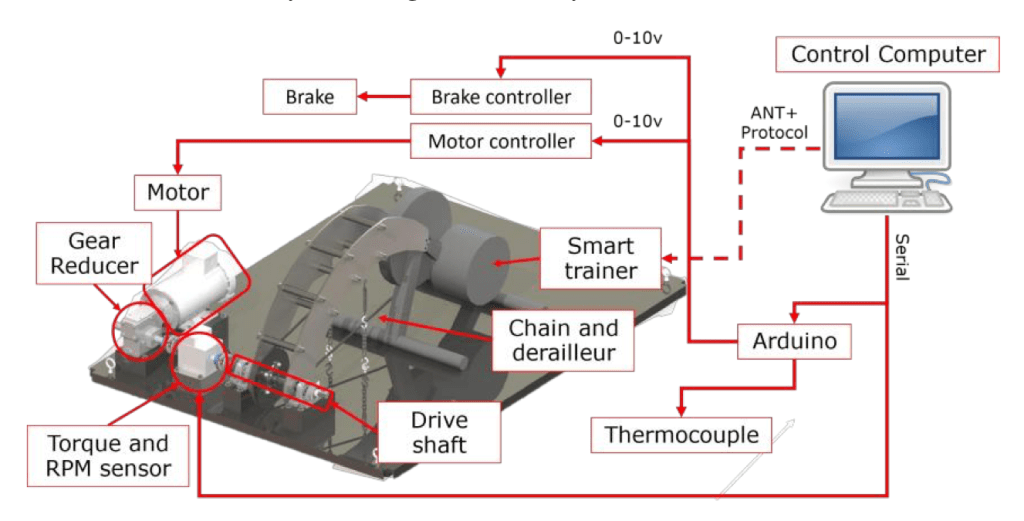
UCI Smart Trainer standardization device
Smart Trainer Homologation Device [Photo: Purdue College of Engineering]

Smart trainer homologation is an independent certification process that evaluates and verifies the accuracy and reliability of different hardware available on the market. A motor is employed to supply a known power to the trainer linked to highly precise torque and rotational measurement sensors. 


The system assesses a trainer’s baseline and dynamic characteristics, examining its reaction to the varying power requirements of a race scenario across the entire spectrum of an athlete’s performance.


Creating a device and protocol to characterize smart trainer behavior is crucial for ensuring fair competition and providing competition organizers and governing bodies, such as the UCI, with the tools to make informed decisions about the integrity of the sport.


“Everyone calculates their metrics differently as power,” Rogers acknowledges the problems associated with variation in smart trainer accuracy across manufacturers.


“We have been working with a university for two years on a protocol for trainer accuracy standardization.” 


Rogers shook his head with a wry smile when asked to share more details about the collaboration. However, an April 2021 report on the Purdue University College of Engineering website pulls back the curtain on the innovative work of the Ray Ewry Sports Engineering Center and potential insight into their collaboration with the UCI.


“In partnership with Purdue University, the UCI is creating a trainer homologation process that evens the playing field and ensures that all athletes have access to an open and fair competition,” Rogers said during an interview for the site.

UCI Smart Trainer Standardization Purdue researchers
Ray Ewry Sports Engineering team members Patrick Cavanaugh (L) and Teal Dowd (R) [Photo: Purdue College of Engineering]

The team of engineers and Ph.D. candidates Patrick Cavanaugh and Teal Dowd, under the leadership of Professor of Engineering Jan-Anders Mansson, recognized the pressing need for smart trainer homologation. 


“In traditional sports, like the racquet in tennis, the equipment is the interface between the environment and the athlete,” describes Cavanaugh.


“In virtual cycling, the trainer is no longer the interface; it is taking the place of the environment, and we need to ensure that all trainers perform the same.”


Their journey into this concept began after observing the virtual Tour of Flanders, a UCI WorldTour race, where Greg Van Avermaet emerged as the virtual victor. However, what caught Mansson’s team’s attention was the fact that all the top finishers were utilizing the same trainer.


“There are different models, different brands, and even different models from the same manufacturer, and they all have their small differences,” Rogers reiterated the necessity for standardization. 


Dr. Mansson and his team have a long and successful history in standardizing sports technology. They began working with the International Olympic Committee (IOC) in 2009 in conjunction with FINA, the International Governing Body of Swimming, for the homologation of swimsuits after 94% of all the races won in the 2008 Beijing Summer Olympics were by swimmers wearing the Speedo LZR Elite swimsuit.


Mansson’s relationship with the UCI began with the homologation of bicycle frames and motor detection and included smart trainers in 2020.


The team at Purdue University is the first to create a homologation system for virtual cycling. This achievement is a significant step toward standardizing virtual racing across all levels of competitions, including international events like the UCI Cycling Esports World Championships and the Olympics.

The testing protocol comprises a fully automated 2 to 3-hour process evaluating power range, resistance accuracy, and hardware reaction to stress factors such as temperature fluctuations. It generates a data analysis plot illustrating the trainer’s response to various slopes and torques across a full dynamic range, simulating racing scenarios. See this June 2022 article published in Engineering of Sports for an in-depth description.


“Different stresses will induce different behaviors in different models,” explained Cavanaugh, “thermal stress being one of them.” 


As an athlete uses a smart trainer during a race, it generates resistance that must be dissipated as heat, profoundly affecting the unit’s performance. The impact comes into play during races of different durations or competition formats consisting of multiple shorter races.

UCI Smart Trainer Standardization - Graphical depiction of homologation data
Graphical depiction of homologation data [Click image for source]

Homologation Procedure

Mansson’s smart trainer homologation protocol is a six-step process that analyzes the following parameters:

  • Steady State Accuracy: compares known power input to power measured by the trainer.
  • Ramp-Up Time Delay: quantifies the time delay between a rider’s increase in speed and the trainer’s response.
  • Ramp Down Time Delay: quantifies the time delay between a rider’s decrease in speed and the trainer’s response o 
  • Resistance Command Accuracy: measures the trainer’s ability to supply the requested torque accurately.
  • Inertial Resistance Accuracy: quantifies how accurately the trainer simulates rider inertia with changing rider speed.
  • Coasting Resistance Accuracy: quantifies how accurately the trainer simulates rider inertia during coasting.

The researchers collect trainer data within a range of rider powers from 100-800W across simulated road gradients from -8 % to 15% to quantify the parameters they developed to capture the full range of conditions a rider may experience during a virtual competition.


Researchers conduct testing on multiple smart trainer units of the same model number and firmware version to homologate a trainer model. Each unit undergoes individual analysis and receives scores for the six homologation criteria and an overall performance score. 


The trainer model is assigned a score based on the lowest overall score among the tested units, according to the description in this June 2022 ISEA Engineering of Sport conference document. The team reports plans to expand the program to include smart bikes in the future. 


Purdue University’s homologation system enables an independent body to certify various bike trainers, assessing their accuracy and reliability. It moves the sport closer to ensuring that what we see on the screen results from an athlete’s abilities rather than equipment errors or limitations, building trust among fans and athletes. 


The UCI-funded program intends to remain independent and reports no plans to monetize or become a commercial entity.


The Purdue engineering team doesn’t intend to communicate directly with hardware manufacturers. That is up to the UCI. However, a solid working relationship is crucial, according to Mansson.


“We are not the trainer police. We aim to improve the sport and ask how to get everyone to the same level. This collaboration is vital to a good homologation program.”


The program will guide the companies in manufacturing hardware with greater intra- and inter-rater reliability and accuracy, raising the bar for the industry.


“The future and credibility of cycling esports rests on the foundation of fair competition,” affirms Rogers. 


Sources indicate that the UCI plans to homologate all of the trainers the racers will use during the live event final of the 2024 UCI Cycling Esports World Championships in Abu Dhabi.


“There is a culture of cheating, and if people don’t believe in the core basics and feel they’re not being part of something fair, it’s hard for that sport to grow.”

UCI Smart Trainer - Trainer Homologation Apparatus Render
Trainer Homologation Apparatus Render [Click Image for Source]

Rogers, the UCI, and Mansson’s team aren’t stopping there to further credible and fair racing. They’ve also looked into wireless communication protocols instrumental in cycling esports, like ANT+ and Bluetooth.


“They’re vulnerable, and we know because we’ve hacked them,” shares Rogers. “We’ve developed solutions to lock them down.” 


The Purdue engineering team developed a process to implement a security protocol within the existing framework of wireless communications. The process encrypts and signs data packets generated at the hardware source.


“It puts a signature on the data packet so that you know it’s from a specific trainer and you can tell if it’s been manipulated,” explains Dowd. 


Additionally, the team can implement sophisticated encryption protocols to prevent intercepted communication from being decoded and recoded into useful data.


Hardware standardization is one aspect of the UCI’s vision for developing cycling esports. 


In October 2023, the UCI offered to The Zommunique’, “For your information, the UCI is currently working on establishing an international calendar and a ranking system for cycling esports and hope to welcome new events in the future.”

The three-tiered approach emphasizes hardware standardization alongside performance verification and virtual platform specifications.


“The UCI plays the role of communicator to bring people to the table to discuss standards,” says Rogers.


He wasn’t keen to offer a timeline when he said, “We are actively working on it, and we will get there eventually.” However, Mansson and his team say they are ready to go with their piece of the puzzle.

Subscribe
Notify of
guest

0 Comments
Inline Feedbacks
View all comments

Latest Podcast!

Virtual Velo Podcast Ep. 88 Jason Osborne
Check out Episode 88 here!
UCI Cycling Esports World Championship LiveBlog
Click to join the fun!

Latest Posts!

Use code ZOMM50 at checkout for $50 off your Velocity Rocker Plate order exclusively for our followers!

Wahoo Run Smart Treadmill
Click the image to be one of the first to get the revolutionary Wahoo Run Smart Treadmill!
Zwift ride frame
Click for complete line of Zwift Bikes!

Do you want to join the VVN team? Tap the logo for details!

The Zommunique’ Community gets 10% off at LEVELVelo.com with coupon code “TheZomm gives 10% off”   

Broadcast Partner to The Virtual Velo Network!

The DIRT Dad Fund

Contribute to a great cause!

The DIRT Dad Fund

Share the power of The DIRT Effect

Click to see the full Zwift product line!

Jaclyn Long, MFT

Certified Yoga & Mindfulness Teacher

Marriage & Family Therapist in CA

Sports Anxiety Therapy

Purchase your Zwift Play controllers here!

0
Would love your thoughts, please comment.x
()
x
The Zommunique
Privacy Overview

This website uses cookies so that we can provide you with the best user experience possible. Cookie information is stored in your browser and performs functions such as recognising you when you return to our website and helping our team to understand which sections of the website you find most interesting and useful.