To establish fan identity and boost viewership, cycling esports broadcasting should elevate its stars and shift the emphasis to relationships.
The league was in bad shape when David Stern took over as commissioner of the NBA in 1984. It was a damaged product that far underperformed its potential. The National Basketball Association had an image problem and not much of a TV audience. Fans couldn’t even watch live. The networks broadcasted the games on tape delay at off-peak times.
The early NBA didn’t have a solid marketing strategy. However, when the competitive upstart American Basketball Association (ABA) needed to do something special to break out, it began highlighting its players. They framed matchups as head-to-head battles between superstars and gave them nicknames like Dr. J (Julius Erving) and the Iceman (George Gervin).
In the late 1970s and early 80s, the NBA declined in popularity and lacked much of a national television audience. It was on the brink of losing relevance.
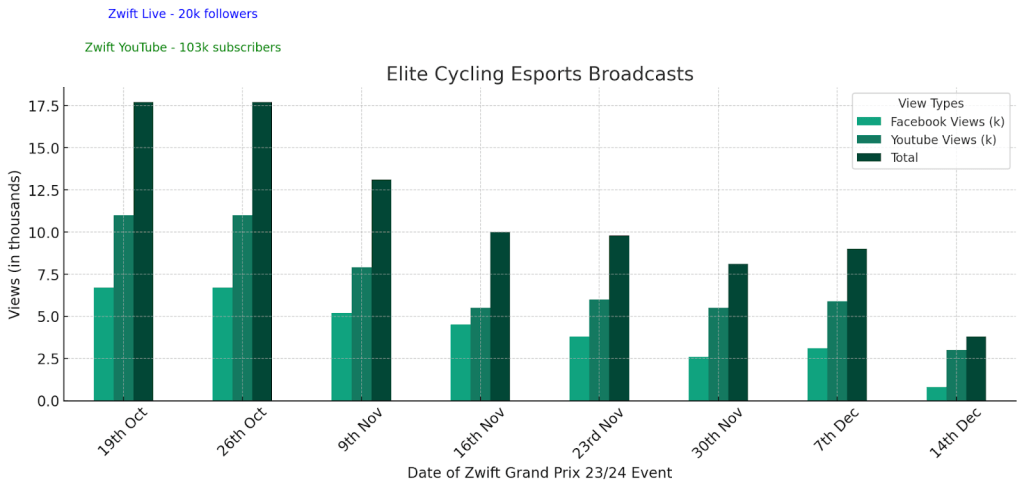
Elite Cycling Esports Broadcasts
| Date | Zwift Grand Prix 23/24 Event | Facebook Views (k) [Zwift Live - 20k followers] |
YouTube Views (k) [Zwift - 103k subscribers] |
Total |
|---|---|---|---|---|
| 19th Oct | Round 1 - Points Hunter | 6.7 | 11 | 17.7 |
| 26th Oct | Round 2 - Mountain Points Race | 6.7 | 11 | 17.7 |
| 9th Nov | Round 3 - ZRL Scratch Race | 5.2 | 7.9 | 13.1 |
| 16th Nov | Round 3 - Women - ZRL Points Race | 4.5 | 5.5 | 10 |
| 23rd Nov | Round 4 - Men ZRL - Team Time Trial | 3.8 | 6 | 9.8 |
| 30th Nov | Round 4 - Women ZRL - Scratch Race | 2.6 | 5.5 | 8.1 |
| 7th Dec | Round 5 - Men ZRL - Points Race | 3.1 | 5.9 | 9 |
| 14th Dec | Round 5 - Women ZRL - Team Time Trial | 0.8 | 3 | 3.8 |
Cycling Esports Has an Identity Crisis
What does the NBA have to do with online bike racing? Cycling esports has an identity crisis. Much like the NBA’s early days, cycling esports platforms lack a clear marketing identity when it comes to elite-level racing. It shows in the stagnant viewership growth and difficulty attracting sponsors.
The global esports market boasted a valuation of $1.88 billion in 2022 and is on track for remarkable growth with a robust CAGR of 26.8% from 2023 to 2030. Sponsorships dominated global market revenue, commanding a share exceeding 39.0% in 2022. These sponsorships empower brands to engage potential customers directly through various online and offline media channels.
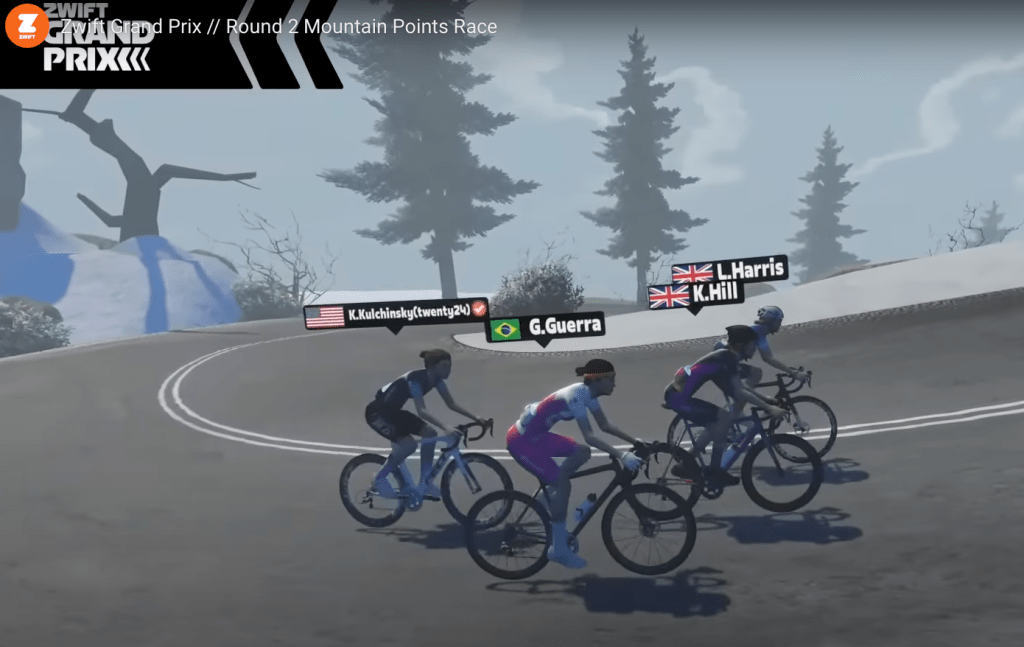
Zwift Grand Prix Women’s Round 2 October 26, 2023
Several key factors drove the market expansion, including the surge in live game streaming, substantial investments, the continuous expansion of audience reach, proactive engagement initiatives, and the development of comprehensive infrastructure for league tournaments.
The growing trend of professionalization in the esports industry is opening up lucrative opportunities for influencers, gamers, event organizers, and game developers. Millennials increasingly embrace esports as a viable and professional career path, driven by the soaring popularity of gaming tournaments, one-to-one sponsorships, streaming revenues, and substantial international prize pools.
Relationship-Based Esports Viewership Motivation
In a September 2023 report entitled “An Exploration of esports fan identity, engagement practices, and motives,” the authors identified the strength of fan identity and relationship-based motives as significant predictors of esports viewing frequency and engagement.
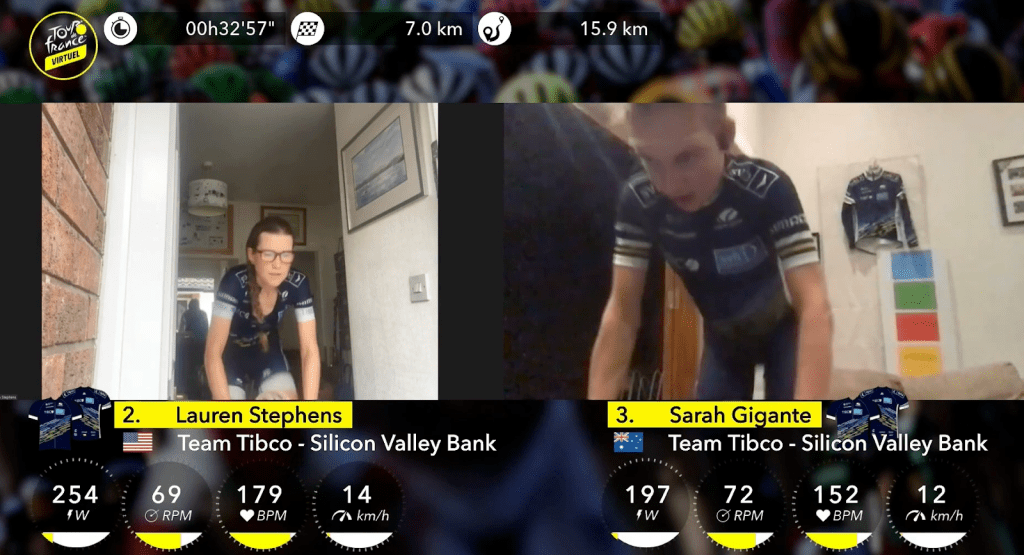
Virtual Tour de France Stage 5 July 18, 2020
According to the researchers, the relationship-based motivation to watch esports is a desire to connect with fellow viewers and the teams or players. Supporters of a particular team or player find added motivation in their relationships with them. This emotional bond between an esports fan and a specific player or team is known as vicarious achievement.
Vicarious achievement is deeply social, fostering a sense of belonging and community. These connections that esports fans build with players or teams make them feel like they’re right there with their favorites, sharing in their victories.
"We need to convey some sort of idea of how hard the race is and the intensity. How many gamers have you met on Twitch who see the Zwift thing and ask if they are actually real people riding?"
Vicki Whitelaw, Aeonian esports racer and former road pro
How can a fan make that personal connection if all they see is an avatar on a screen? For individuals viewing cycling esports for the first time without prior knowledge, little indicates that actual athletes power the avatars.
Present Product-Centric Focus
Present elite-level cycling esports broadcasts are product-centric. There is a significant emphasis on highlighting on-screen assets and commentary that primarily revolves around explaining the platform and its components. Creating storylines, developing rivalries, and giving a personality to the avatar is secondary. Cycling esports has some fantastic personalities, but the onus is on the individual athletes to tell their own stories.
“From what my viewers tell me, they return to my channel for dialogue, conversation, and community. It has taught me that one of the most important elements of live content is the viewer's level of connection to the broadcast.”
Pookiebutt, Zwift Twitch Live Streamer
Look no further than the vibrant Zwift streaming community for a successful formula. Many have evolved over years of experience interacting in the racing community. There, it is clear that an essential element of live content is the level of connection the viewer makes with the broadcast presentation.
Elite-level broadcasts must connect with fans meaningfully to change their attitude and behavior towards cycling esports. Convey the physical intensity and emotional struggle personally through live rider feeds, but do so in an interesting and impactful manner.
Show a diverse array of athletes for longer and at strategic points in the event. The racers at the back look discouraged and defeated, suffering the agony of defeat, or those emptying the tank, clawing to stay attached to the group. If four riders are going for a sprint point, why not have their live feeds on the screen so you can relate the effort they’re putting in? Put up all the riders in the break, allow the viewers to witness the ups and downs, and form a dramatic story in their minds.
“While cycling esports live broadcasts - particularly those pertaining to ZRL, ZGP, and the World Championships - have come a long way in a short space of time, I feel more can be done to bring across the human element. There’s a bit too much gameplay shown and when it does cross over to a live feed, the same riders/personalities seem to be shown over and over. It would be great to mix it up - to see more diversity, perhaps riders at the back or those trying to make it back to the peloton.”
Aaron Borrill, ZGP elite racer, and cycling journalist
Include audio communications between athletes and their DS via Discord. Show viewer engagement with on-screen fan comments and questions to the commentators and guest athlete speakers.
“I also feel the production could be longer with more inserts on teams, riders, and managers and more interviews from riders after the race. An interesting touch would be for the broadcast to have access to team Discord streams, especially when there’s a decisive move in a scratch or points race or when there is a TTT. This will take the broadcast to a whole new level and create a more immersive experience for the viewers who can both see and hear the pain and suffering and better understand tactics as they play out.”
Aaron Borrill
Creating the Essential Viewer Connection
A player’s experience and a spectator’s experience are interconnected. It starts with pre- and post-race interviews and expert commentary during the race, laying the foundation. Background information about the racers, their achievements across various platforms, and insights into their personal lives or professions provide context. Virtual podium and series-ending awards ceremonies enhance the vicarious excitement.
"More effort could be put into elevating the true champions of the platforms, the packs need to be smaller, and we need podium ceremonies after the races and series."
Rhys Howell, Coalition Alpha founder/director and media marketer
To fully develop the storylines, it’s essential to define the characters. Reducing pack sizes or splitting elite events into two divisions allows for a more concentrated focus on a select group of racers. Additionally, establishing a clear promotion and relegation portal for elite esports rankings and participation is crucial for fostering that connection, giving amateurs a clear path to the pros.
By elevating the true champions of the sport, rather than marketing road racing pros without a vested interest as the face of the platform, esports will develop homegrown stars. Talents and personalities that the cycling esports community can aspire to be.
However, nothing grows, and little happens if no one knows. Post-race results have to be efficient, accessible, and publicized. Platforms must share team and roster announcements with fanfare worthy of the pinnacle of the fledgling sport trying to gain a foothold.
“This tech-savvy sport has so much potential to produce thousands of hours of high-quality content. Pre- and post-race interviews, press conferences, team and roster announcements, and stats, TONS of stats!”
Zach Nehr, NeXT eSports pb Enshored racer and cycling journalist
Characters, Rivalries, and TONS of Stats
Building fan identity in cycling esports extends beyond relationship-based motives. The platforms can depict drama through an abundance of statistics and data. Cyclists are tech-savvy, and esports racers and fans are even more so. Head-to-head racer and team records, highlights of previous races on similar courses, and side-by-side athlete power comparisons add intrigue. Start by showing speed on the screen.
Or, look back to 2020 and the six-stage Virtual Tour de France. The momentous event marks its place in cycling history as the first time le tour saw true gender parity. However, it’s what esports fans saw on the screen that they can’t forget and long for now.
A viewer interface with elapsed race time, total ascent, distance covered, and incline lay neatly over the digital course. It featured rider stats, including power, cadence, heart rate, and velocity. There were side-by-side real-world rider cams, pre-and post-race interviews, and race recap highlights. You can watch the video here.
Cycling Esports has all the elements of a good story: strong characters, fierce rivalries, struggle in the face of adversity, and vast data-sourcing potential. What will it take to give the avatar a face and cycling esports an identity? Take a lesson from the past.
You only get one chance to make a first impression. Every squandered opportunity is a step backward for cycling esports.
To subscribe to the Zommunique and receive more informative and entertaining articles like this one sent directly to your inbox, click here!
Semi-retired after more than 20 years as the owner and director of a private Orthopedic Physical Therapy practice, Chris now enjoys the freedom to dedicate himself to his passions—virtual cycling and writing.
Driven to give back to the sport that has enriched his life with countless experiences and relationships, he founded a non-profit organization, TheDIRTDadFund. In the summer of 2022, he rode 3,900 miles from San Francisco to his “Gain Cave” on Long Island, New York, raising support for his charity.
His passion for cycling shines through in his writing, which has been featured in prominent publications like Cycling Weekly, Cycling News, road.cc, Zwift Insider, Endurance.biz, and Bicycling. In 2024, he was on-site in Abu Dhabi, covering the first live, in-person UCI Cycling Esports World Championship.
His contributions to cycling esports have not gone unnoticed, with his work cited in multiple research papers exploring this evolving discipline. He sits alongside esteemed esports scientists as a member of the Virtual Sports Research Network and contributes to groundbreaking research exploring the new frontier of virtual physical sport. Chris co-hosts The Virtual Velo Podcast, too.
Chris:
As a fan, I love that you bring this up. I was really into the ZGP when it started – I scheduled meetings around it and made sure I was going to be available to watch it live. And I did thoroughly enjoy it – I have friends racing and that extra connection is great. But that excitement has faded away in proportion with my awareness of the events. I believe I’m subscribed for the events and want to know when they are happening; the first event seemed everywhere, the second a bit less so; the third, I think was when I tuned in and was confused when only the women raced… and didn’t really hear what that meant – the why and even when the men would be racing. And then I haven’t seen another, fell right off my radar. Still super interested and could be invested and I feel like I would watch if I knew about it – even with the state of current broadcasting. But, from my experience, the ZGP seems to have evaporated entirely. Did it get disbanded??
Your assessment is an accurate depiction of the current state of affairs, Walt. As you know, I’m a big fan. However, when I watch I say to myself that if I wasn’t so heavily invested I wouldn’t continue to watch.
That’s not to mention the seemingly non-existent promotion. Observing the lack of awareness of the events by the community, I decided to publish a preview that goes out before each race with viewing details. It’s the only promotion other than team and racer-generated social media that I’m aware of.
Something needs to be done or the sport will become irrelevant.
Thank you for the comment. Happy holidays, my friend!