By Adam Upshaw, PhD
Is it finally time to re-image the role of 'quick fix' carbohydrates before and during our cycling training routines?
When I ride through Zwift land, I am often intrigued, as an exercise physiologist and nutrition researcher, by the conversations around food and fueling for your workout. The gels, sports drinks, candy, fig newtons, and, of course, the beloved donut are only some of the top go-tos for the ultimate energy source for shorter but more intense rides and long zone 2-type sessions.
For decades, the conventional wisdom in sports nutrition has touted the benefits of high carbohydrate intake before and during exercise. Many experts champion carbs as the king of fueling for athletes, driving performance and recovery. However, new thought-provoking research highlights the growing trend towards the benefits of a diet high in fat and low in carbohydrates to fuel even your most intense workouts.
Further, recent studies have spotlighted the potential risks of excessive carbohydrate consumption by athletes to fuel their workouts. It turns out that chronically flooding your system with carbs, especially simple sugars, can wreak havoc on your blood sugar levels and insulin response. Over time, one could increase their risk of insulin resistance, a precursor to type 2 diabetes and metabolic syndrome, obesity, and cardiovascular disease.
It should be noted, before diving in, that the following discussion is not about demonizing carbs or issuing a statement that athletes should avoid carbohydrates. Instead, it is a call to reevaluate our approach to fueling our bodies. It is about seeking a more comprehensive approach supporting our immediate athletic endeavors and overall health and well-being.
First, let us take a quick look at why nutrition experts and athletic performance professionals promote carbohydrate intake as vital to exercise and physical performance.

Why is carbohydrates such a valued commodity for fueling the athlete?
The experts have long revered that this energy-rich macronutrient is the primary source of dietary glucose, the crucial energy currency for high-octane muscle activity during high-intensity and endurance-based activities. The body’s ability to store carbohydrates as glycogen within the muscle (as well as the liver) provides a much-needed reservoir of readily available energy for the muscle.
Glucose is the preferred energy source for the exercising muscle
Thus, we understand that consuming carbohydrates prepares the muscle for activity and allows the muscle to continue to perform work once these reservoirs become depleted (lowered). Research from Hawley and Burke (2010) emphasized the capacity of carbs to sustain energy levels and stave off exhaustion during prolonged workout sessions. To this end, Hawley et al. (1997) noted in their review that high muscle glycogen concentration (and liver glycogen), obtained through high carbohydrate feeding before exercise, improved performance by 2-3%.
We can strengthen said performance further by consuming carbohydrates before exercise and carbohydrates during exercise, usually in intervals of 30-45min at a rate of anywhere between 60-90g/h up to 120g/hr for those at the most elite levels. Smith et al. (2013) concluded that the most significant oxidation rate of carbohydrates, and subsequently, the greatest performance enhancement, was seen at an ingestion rate between 60 and 80 g of carbohydrates per hour.”
Also Read:
Scientific Pause – what do these oxidation rates mean?
Carbohydrate oxidation is the production of ATP, the body’s energy-rich molecule, through the breakdown of glucose, a simple sugar that contributes to our body’s blood sugar – or blood glucose levels. When more carbohydrates are oxidized, specifically in the muscle (glucose stored in the muscle – and liver – is termed glycogen), more energy is available for the muscle to perform work.
Your exercising muscles can burn glucose at very high rates to allow for maximum performance
Similarly, more energy is available for the muscle as more liver glycogen and exogenous carbohydrates (consumed carbohydrates) are oxidized. Margolis et al. (2019) show that carbohydrate oxidation rates decreased when exercising with low muscle glycogen content. Similarly, Jentjens (2006) found that carbohydrate oxidation rates increased as the provision of carbohydrates increased to 1.5g/min (90g/hr). All to suggest that higher carbohydrate oxidation rates support high energy-requiring activities.
If more carbohydrates are available to working muscles, it would be reasonable to assume that carbohydrate loading (eating large amounts of carbohydrates pre-exercise) and ingesting carbohydrates during exercise would benefit exercise outcomes and performance.

But what about fat, the body's other high energy-producing macronutrient?
Dietary fat is an essential component of an athlete’s diet and has historically proven effective for low and moderate-high-intensity exercise. Fat provides a concentrated energy source, with one gram of fat providing nine calories, making it an efficient fuel source. The intake of a higher-fat diet can lead to increased fat oxidation during exercise, which is viewed favorably simply as a sparing mechanism for muscle glycogen, which then delays the onset of fatigue during high-intensity performance (Havemann et al., 2006).
Recently, however, high-fat diets (~70-80 % of total daily energy) may be able to foster a physiological environment that favors increased fat oxidation rates at intensities even greater than moderate (~60% Vo2max) or even high (>85% Vo2max). Indeed, Prins et al. (2023) found that elite cyclists following a low carbohydrate, high-fat diet had fat oxidation rates at intensities of > 85% Vo2max, like oxidation rates from longer, more moderate-intensity exercise (~65% Vo2max).
When glucose is not readily available, dietary fat appears to a be good replacement for most exercise intensities
The significance of these findings is that even when muscle glycogen is not optimal because of chronic low carbohydrate intake, fat oxidation increases to a level that maintains high-intensity performance compared to a more conventional higher carbohydrate intake. It further highlights that it is, in fact, diet, and not exercise intensity, that primarily dictates fat oxidation (use) during exercise.
Even when cycling at a ‘zone 2’ effort, if you are constantly fueling with carbohydrates, carbohydrates will be your primary fuel. Similarly, you will elevate fat oxidation in ‘zone 2’ (or arguably higher) whether you exercise fasted or follow a low carbohydrate dietary regimen. It means there is no need to fast for your low-moderate intensity endurance efforts if you have been minimizing your carbohydrate intake. In layperson terms, do not exercise hungry; eat something other than carbohydrates, and you’ll ‘burn’ fat for fuel.
But I see all the pros consuming carbohydrates. Can fat actually do it?
As the saying goes, “depends on who you ask.” There is no doubt an abundance of evidence supporting the notion that a diet higher in carbohydrates promotes elevated muscle glycogen levels. What needs to be clarified is whether lower rates of muscle glycogen result in premature performance fatigue or if fatigue is more preoccupied with blood glucose levels—a physiological variable that can be sustained on a low carbohydrate diet with small doses of exogenous carbohydrates during exercise.
Because blood glucose and not muscle glycogen appears to be the key for performance, high daily carbohydrate intakes are not necessary
As prominent (and often controversial) exercise physiologist Timothy Noakes has argued, blood glucose concentration derived from carbohydrates stored in the liver and not the muscle drives endurance performance – at both moderate and high intensities. The idea that blood glucose dictates fatigue is not new.
A paper by Levine et al. (1924) speculated that blood glucose drives fatigue during a marathon. Regardless of whether you begin your exercise session with low or high muscle glycogen, the homeostatically-regulated blood glucose is responsible for the onset of your performance fatigue.

And what can maintain blood glucose during exercise?
Our gels, sports drinks, and candies indeed can, but not necessarily at the recommended levels. Researchers argued that as little as ~30g/h would be more than enough to maintain blood glucose. This figure mimics the current recommendations for carbohydrate intake during long-duration exercise for those with diabetes to stave off hypoglycemia (Diabetes Canada, 2023).
You only need to consume small amounts of sugar during exercise for most endurance activities
So even though maximum carbohydrate oxidation rates in the muscle of 60-90g/h are proposed (or even 120g/h – Viribay et al. 2020), you may require only enough exogenous carbohydrates (~20-30g/h) to maintain blood glucose at most intensities.
This idea of a lower dose of carbohydrates during exercise does not have enough evidence to counter the widely held view that muscle glycogen and not blood glucose is of primary concern. However, given recent original research on the topic, experts suspect a more precise answer is coming down the pipeline. Nevertheless, at this point, we do not have enough evidence to support the high consumption of carbohydrates pre-, during, and post-exercise and the possible implications such practices have on our health.
Also Read:
Health consequences from the promotion of high carbohydrate (and high fat) diets
A high-carbohydrate diet, especially one high in refined sugars, like our gels, sports drinks, chewies, candies, and cookies, can have negative health consequences. Consuming too many simple carbohydrates can lead to spikes in blood sugar levels, which can contribute to insulin resistance and an increased risk of type 2 diabetes and cardiovascular disease.
Prins et al. (2023) tested highly trained competitive middle-aged athletes who underwent two 31-day isocaloric diets (High-carbohydrate, low-fat {HCLF} OR low-carbohydrate, high-fat {LCHF}) in a randomized, counterbalanced, and crossover design with controlled kcal intake and training load. Researchers noted that while “…all subjects were “healthy,” with normal body weight and BMI, and competitive middle-aged athletes without any medical diagnoses, we observed that when continuously monitoring glucose parameters over 31 days, 30% of subjects on an HCLF diet had mean, median, and fasting [blood glucose] > 100 mg/dL, consistent with pre-diabetes interstitial glucose.”
They continue, “[t]hese subjects fitting the pre-diabetes glycemic phenotype in our study could not be explained by underlying demographics, body composition or physical activity differences as these pre-diabetic subjects had near equivalent age, running, lower weight, BMI and body & kg and higher VO2max.”
The significance of such a finding is that although not everyone would develop unfavorable glycemic control because of a high carbohydrate diet, determining who would before its manifestation is complex.
Daily high carbohydrate intake, as advised for endurance athletes, is not necessary for most people and could lead to an increased risk of negative health outcomes
Additionally, Kelly et al. (2023) observed that a higher free sugar (added sugar) intake was significantly positively associated with cardiovascular disease risk (CVD), while Jo et al. (2023) noted in their systematic review and meta-analysis that CVD risk increased when carbohydrates made up more than 60% of total energy intake. Consuming added sugars and high daily carbohydrate intake are two widely accepted nutritional habits of endurance athletes, and thus, minimizing intake would appear advantageous.
Similarly, a diet high in saturated fats has implications for heart disease due to its ability to raise apolipoprotein B—a protein used to detect atherosclerotic cardiovascular disease. Before we lose all the low-fat advocates, it’s not suggesting that we fear and avoid saturated fats as many in the health sciences taught us to believe; at this point, the overwhelming research indicates a moderation of saturated fat intake will have positive cardiometabolic benefits.
Further, excessive fat consumption can contribute to weight gain, as fat is calorie-dense and can lead to an overconsumption of calories. Of course, a high-fat diet does not need to mean a high intake of saturated fats. Many nutritious fats, such as mono–and poly-unsaturated fats, can make up a considerable proportion of one’s dietary fat intake.
This list includes nuts, seeds, avocados, fish, oils, nut butter, and soybeans. Nutrition experts recommend these fats for individuals following a high-fat diet. And yes, consuming fats on a per-gram basis will contribute to a higher caloric intake (9kcal per gram of fat vs ~4kcal per gram of carbohydrate), which brings the possibility of a positive energy balance (weight gain).
- Traditional View on Carbohydrates: Historically, nutrition and performance experts have recommended high carbohydrate intake before and during exercise for athletes, viewed as essential for optimal performance and recovery, but new research is challenging this belief.
- Risks of Excessive Carbohydrate Consumption: Overconsumption of carbohydrates, especially simple sugars, can negatively impact blood sugar levels and insulin response, potentially leading to insulin resistance, obesity, and cardiovascular disease.
- Reevaluating Carbohydrate Strategies: There is a growing trend towards diets higher in fats and lower in carbohydrates, which can still fuel intense workouts effectively.
- Carbohydrate Oxidation and Performance: Consuming carbohydrates prepares muscles for activity and can sustain energy levels during prolonged sessions. Optimal carbohydrate ingestion rates for maximum performance range between 60-90g/h.
- Role of Dietary Fat: High-fat diets can increase fat oxidation during exercise, potentially sparing muscle glycogen and delaying fatigue, even at high intensities.
- Low Carbohydrate, High Fat Diet in Practice: Elite athletes following such diets can maintain high-intensity performance even with lower muscle glycogen levels due to increased fat oxidation.
- Carbohydrates vs. Fats in Fueling: Experts see carbohydrates and fats as adequate primary fuel sources for high-level performance. However, they recommend a balanced approach, considering the health risks associated with high carbohydrate consumption.
- Minimal Carbohydrate Needs During Exercise: Experts in the field speculate that consuming small amounts of carbohydrates (around 30g/h) can be sufficient to maintain blood glucose levels during exercise.
- Health Risks of High Carbohydrate and High Fat Diets: If not balanced, both diets can lead to adverse health outcomes like cardiovascular disease and insulin resistance.
- Reimagining Carbohydrate Roles: Adopting a nuanced approach to nutrition, prioritizing health and wellness alongside performance, is essential.
- Individualized Nutrition Approaches: Athletes should consider their specific situations and needs, balancing carbohydrate and fat intake for optimal performance and health.
I am confused! Which is it – carbs or fats? Here is the clarifier.
The sports science and nutrition fields entrench the promotion of high carbohydrate intake for endurance athletes. Preloading and consuming high amounts of carbohydrates post-exercise, in addition to regular high intake of refined carbohydrates during exercise, especially long sessions, is a fueling strategy practiced by most amateur and high-level, as well as elite, athletes.
How can we argue that better strategies exist than this one? As mentioned, there is still much to explore in this area. However, when we contemplate the potential of a low-carb diet to facilitate high-level (and high-intensity) performance and training while considering the risks associated with consuming high daily quantities of carbohydrates (particularly refined carbohydrates), we should advocate for a more moderate and cautious approach to dietary carbohydrates when formulating fueling strategies for workouts and races.
The honest debate about carbs versus fats for fuel primarily revolves around the elite level of performance, specifically, whether carbohydrates are essential for achieving optimal energy output at the most intense levels in most endurance events. We lack sufficient evidence to fully support a viewpoint favoring fat as the primary fuel source, and the body of research on this topic predominantly supports a carbohydrate-rich approach.
However, for most of us who are not elite athletes and do not engage in consistently high-intensity training, promoting a carbohydrate-rich diet carries more health risks than benefits.
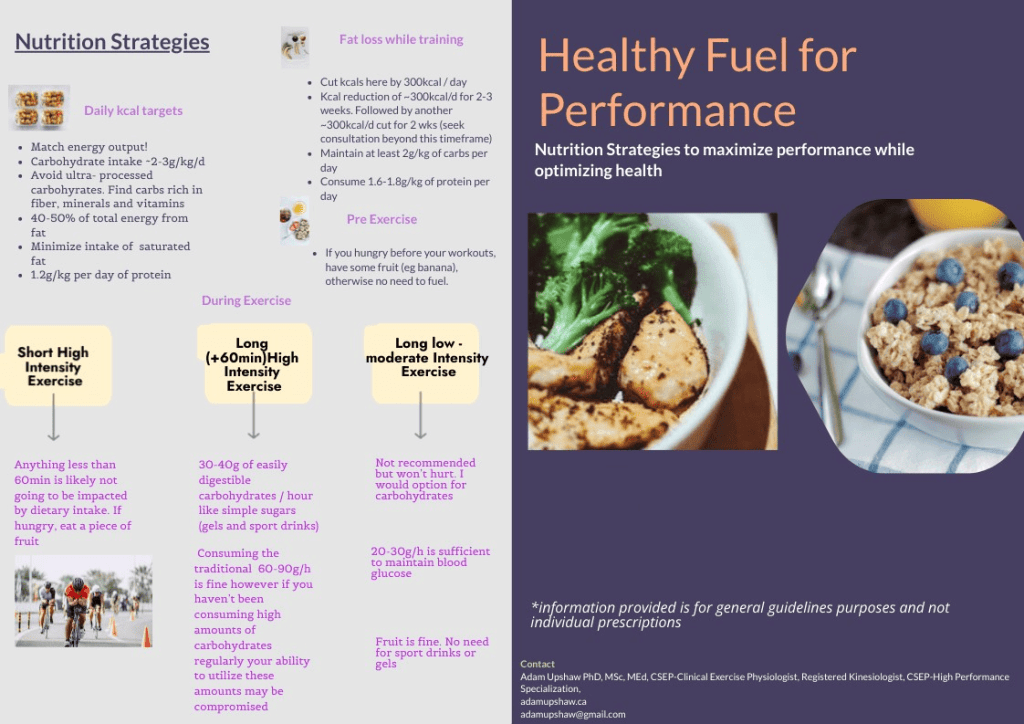
At its essence, exercise nutrition isn’t overly complex—it’s the ‘experts’ who often complicate it. To cut through the confusion, the infographic below emphasizes the fueling strategies I endorse, drawing from a comprehensive perspective rooted in the best available research to date.
While these are general guidelines, it’s essential to recognize that specific situations and individual needs may necessitate a more nuanced approach to optimization. Nonetheless, this serves as a guide that supports adequate exercise fueling and, more importantly, enhances your overall health and well-being.
The bottom line?
It is time to reimagine the role of carbohydrates in our exercise routine. By embracing a more nuanced approach to nutrition that prioritizes health over performance, we can set the stage for a lifetime of wellness.
References
Hawley JA, Burke LM. Carbohydrate availability and training adaptation: effects on cell metabolism. Exerc Sport Sci Rev. 2010 Oct;38(4):152-60.
Hawley JA, Schabort EJ, Noakes TD, Dennis SC. Carbohydrate-loading and exercise performance. An update. Sports Med. 1997 Aug;24(2):73-81
Smith JW, Pascoe DD, Passe DH, et al. Curvilinear dose–response relationship of carbohydrate (0–120 g/h) and performance. Med Sci Sports Exerc. 2013
Margolis LM, Wilson MA, Whitney CC, Carrigan CT, Murphy NE, Hatch AM, Montain SJ, Pasiakos SM. Exercising with low muscle glycogen content increases fat oxidation and decreases endogenous, but not exogenous carbohydrate oxidation. Metabolism. 2019 Aug;97:1-8.
Jentjens RL, Underwood K, Achten J, Currell K, Mann CH, Jeukendrup AE. Exogenous carbohydrate oxidation rates are elevated after combined ingestion of glucose and fructose during exercise in the heat. J Appl Physiol (1985). 2006 Mar;100(3):807-16.
Havemann L, West SJ, Goedecke JH, Macdonald IA, St Clair Gibson A, Noakes TD, Lambert EV. Fat adaptation followed by carbohydrate loading compromises high-intensity sprint performance. J Appl Physiol (1985). 2006 Jan;100(1):194-202.
Prins PJ, Noakes TD, Buga A, D’Agostino DP, Volek JS, Buxton JD, Heckman K, Jones DW, Tobias NE, Grose HM, Jenkins AK, Jancay KT, Koutnik AP. Low and high carbohydrate isocaloric diets on performance, fat oxidation, glucose and cardiometabolic health in middle age males. Front Nutr. 2023 Feb 9;10:1084021
Levine SA, Gordon B, Derick CL.. Some changes in the chemical constituents of the blood following a marathon—with special reference to the development of hypoglycemia. JAMA. 1924;82:1778–1779
Diabetes Canada. 2023. https://www.diabetes.ca/managing-my-diabetes/tools—resources/physical-activity
Viribay A, Arribalzaga S, Mielgo-Ayuso J, Castañeda-Babarro, Seco-Calvo J, Urdampilleta A. Effects of 120 g/h of Carbohydrates Intake during a Mountain Marathon on Exercise-Induced Muscle Damage in Elite Runners. Nutrients 12(5), 1367, 2020
Kelly, R.K., Tong, T.Y.N., Watling, C.Z. et al. Associations between types and sources of dietary carbohydrates and cardiovascular disease risk: a prospective cohort study of UK Biobank participants. BMC Med 21, 34 (2023).
Jo U, Park K. Carbohydrate Intake and Risk of Cardiovascular Disease: A Systematic Review and Meta-Analysis of Prospective Studies. Nutrients. 2023 Apr 2;15(7):1740
Social Blurb: Daily high carbohydrate intake, as advised for endurance athletes, is not necessary for most people and could lead to an increased risk of negative health outcomes.
To subscribe to the Zommunique and receive more informative and entertaining articles like this one sent directly to your inbox, click here!

Semi-retired after more than 20 years as the owner and director of a private Orthopedic Physical Therapy practice, Chris now enjoys the freedom to dedicate himself to his passions—virtual cycling and writing.
Driven to give back to the sport that has enriched his life with countless experiences and relationships, he founded a non-profit organization, TheDIRTDadFund. In the summer of 2022, he rode 3,900 miles from San Francisco to his “Gain Cave” on Long Island, New York, raising support for his charity.
His passion for cycling shines through in his writing, which has been featured in prominent publications like Cycling Weekly, Cycling News, road.cc, Zwift Insider, Endurance.biz, and Bicycling. In 2024, he was on-site in Abu Dhabi, covering the first live, in-person UCI Cycling Esports World Championship.
His contributions to cycling esports have not gone unnoticed, with his work cited in multiple research papers exploring this evolving discipline. He sits alongside esteemed esports scientists as a member of the Virtual Sports Research Network and contributes to groundbreaking research exploring the new frontier of virtual physical sport. Chris co-hosts The Virtual Velo Podcast, too.