Counteract Dynamic Muscle Shortening and Reflex Inhibition to Overcome Upper Crossed Syndrome When Cycling
Cycling is a sport that demands intricate and synchronized neuromuscular coordination. Two critical physiological processes significantly impacting cycling performance are dynamic muscle shortening and reciprocal inhibition. Grasping these concepts can aid cyclists in enhancing their performance and avoiding injuries.
Under normal circumstances, the interaction between opposing muscles helps us to maintain a proper upright cycling posture. However, the progressively sedentary lifestyle of the modern world, marked by extended periods of sitting—whether at work or even while cycling—can manipulate these physiological mechanisms. The interplay could potentially influence cycling performance and overall health by leading to a condition known as Upper Crossed Syndrome.
Dynamic Muscle Shortening and Reciprocal Inhibition:
A Crucial Upper Crossed Syndrome Interplay for Cyclists
Dynamic Muscle Shortening
Dynamic muscle shortening is a physiological process where muscle contracts and reduces in length while exerting force. In the context of cycling, this concept is not only applicable to the lower body, but also crucial for the upper body, especially when considering conditions like Upper Crossed Syndrome (UCS).
The imbalance in the musculature around the neck, shoulders, and chest characterizes UCS. For instance, prolonged cycling can shorten and tighten the pectoral and upper trapezius muscles and lengthen and weaken the deep neck flexors and lower trapezius muscles that oppose them when maintaining an upright cycling posture.
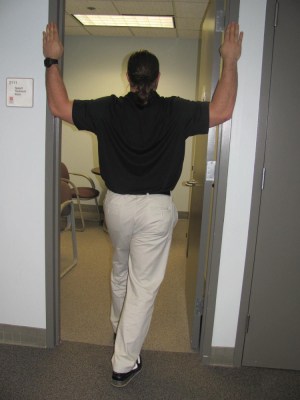
Understanding dynamic muscle shortening in the context of UCS can guide cyclists in developing targeted strength and stretching routines. For example, exercises that stretch the pectoral and upper trapezius muscles, such as the doorway stretch, can help counteract the muscle shortening. Simultaneously, strengthening exercises for the deep neck flexors and lower trapezius muscles, like the chin tuck or prone cobra, can help address the muscle weakness and lengthening. These exercises can be particularly beneficial in managing and preventing UCS in cyclists.
Also Read:
Reciprocal Inhibition
Reciprocal inhibition, or reciprocal innervation, is a neuromuscular reflex integral to normal movement. It involves the automatic relaxation of a muscle (antagonist) in response to the contraction of the opposing muscle (agonist), facilitating fluid and coordinated motion.
In the context of cycling and Upper Crossed Syndrome (UCS), consider the action of the muscles around the shoulder. When you’re gripping the handlebars and your pectoral muscles contract, reciprocal inhibition causes your opposing muscles, the rhomboids, and lower trapezius, to relax. This mechanism ensures efficient movement by preventing opposing muscle groups from counteracting each other.
The principle of reciprocal inhibition also highlights the importance of balanced strength training for cyclists, mainly to prevent conditions like UCS. Suppose the pectoral muscles are excessively stronger than their antagonists, the rhomboids, and lower trapezius. In that case, they can over-inhibit these weaker muscles, leading to imbalances, poor posture, and increased risk of conditions like UCS.
To maintain this balance, cyclists should ensure their training routines adequately target all major muscle groups involved in cycling, not just those traditionally associated with power production. For example, while the pectoral muscles and upper trapezius are crucial for maintaining a strong grip on the handlebars, the rhomboids and lower trapezius, active in maintaining proper posture and preventing UCS, should not be neglected. Exercises such as scapular retraction and prone cobra can help strengthen these muscles and prevent the development of UCS.
What is Upper Crossed Syndrome?
Upper Crossed Syndrome (UCS) is a common musculoskeletal condition, especially among cyclists, characterized by muscle imbalances in the upper body. These imbalances can lead to chronic neck pain, a common complaint among cyclists. Understanding and addressing UCS can help cyclists manage and prevent neck pain, enhancing comfort and performance.
UCS is characterized by the overactivity and tightness of the upper trapezius and levator scapulae (muscles in the upper back and neck) and the pectoralis major and minor (chest muscles). Simultaneously, there’s underactivity and weakness in the deep neck flexors (front of the neck) and the lower trapezius and serratus anterior (lower back and under the shoulder blade). This pattern forms an “X” or a cross, hence the name Upper Crossed Syndrome.
Dynamic Muscle Shortening and the Cycling Sitting Problem—
Upper Crossed Syndrome When Cycling
Dynamic muscle shortening is a physiological process where a muscle contracts, reducing its length while exerting force. For cyclists, this is particularly relevant to the upper body’s muscles, such as the pectoralis major and the upper trapezius, when maintaining a forward-leaning position on the bike. These muscles contract or shorten to support the upper body’s weight.
However, prolonged periods in this forward-leaning position, whether during long cycling rides or while working at a desk, can lead to a condition often called “adaptive shortening.” In this scenario, the muscles of the upper body, particularly the pectoralis major and the upper trapezius, can become habitually shortened due to remaining in a contracted position for extended periods.
Adaptive muscle shortening occurs when muscles adjust their functional resting length to adapt to the length at which they are habitually used or positioned. This can create an imbalance, reducing the range of motion, impairing cycling posture, and potentially leading to discomfort or injury, such as Upper Crossed Syndrome (UCS).
Incorporating strength and flexibility exercises that target these muscles can help mitigate this issue and maintain the dynamic muscle length necessary for optimal cycling performance and posture.
Reciprocal Inhibition and the Consequences of Prolonged Sitting To Upper Crossed Syndrome in Cyclists
Reciprocal inhibition is a neuromuscular reflex that facilitates smooth movement, causing a muscle (antagonist) to relax when the opposing muscle (agonist) contracts. For cyclists, this is particularly relevant to the muscles of the upper body. For instance, when the pectoralis major contracts to maintain a forward-leaning position on the bike, reciprocal inhibition triggers the relaxation of the opposing muscles, such as the rhomboids and lower trapezius.
However, prolonged periods in this forward-leaning position can disrupt this balance, whether during long cycling rides or while working at a desk. The continued contracted position leads to overactive, shortened pectoralis major and upper trapezius muscles and underactive, lengthened rhomboids and lower trapezius muscles. This imbalance is often termed “Upper Crossed Syndrome” (UCS).
UCS represents a postural imbalance predominantly centered around the upper body muscles. The imbalance can affect an individual’s movement and posture, leading to pain or discomfort. Specific patterns of muscle weakness and tightness crisscrossing between the body’s dorsal (back) and ventral (front) sides characterize upper crossed syndrome in cyclists.
The imbalance negatively affects the reciprocal inhibition process. The overactive muscles excessively inhibit the antagonist muscles, causing inefficient movement and a compromised cycling posture.
In prolonged cases, the imbalance can compromise the nerves that signal the muscle fibers to fire, leading to conditions such as UCS.
Targeted exercises to strengthen the rhomboids and lower trapezius and stretch the pectoralis major and upper trapezius can help restore muscle balance, preserve efficient reciprocal inhibition, and enhance cycling posture and performance.
Implement these three key strategies to counteract the adverse effects of Upper Crossed Syndrome in cyclists: stretching, strengthening, and proper bike fitting.
Stretching: Reversing Adaptive Shortening For Cyclists With Upper Crossed Syndrome
Regular stretching can significantly help reverse adaptive muscle shortening caused by prolonged periods in a forward-leaning position, such as when cycling or working at a desk. It can increase flexibility, improve the range of motion, and counteract reciprocal inhibition.
Here are the primary muscles cyclists should focus on:
- Pectoralis Major: Extended periods in a forward-leaning position can cause these muscles to become tight and shortened. Performing regular chest stretches can help restore their normal length and flexibility.
- Upper Trapezius: These muscles, which run along the sides of the neck, can become tight due to maintaining a forward-leaning position. Regular upper trapezius stretches help improve flexibility and reduce tension.
- Rhomboids and Lower Trapezius: These muscles, located in the upper and mid-back, can become lengthened and underactive due to the forward-leaning position. Regularly stretching and strengthening these muscles can help maintain their function and counteract the effects of Upper Crossed Syndrome.
Strengthening: Countering Upper Crossed Syndrome For Cyclists
To counter Upper Crossed Syndrome—characterized by weak deep neck flexors, lower and mid trapezius, and tight upper trapezius and pectoralis major—targeted strengthening exercises should be integrated into your training routine. These exercises can restore muscle balance and optimize the dynamic muscle shortening and reciprocal inhibition processes.
Key muscle groups to focus on include:
- Deep Neck Flexors: Strengthening exercises for the deep neck flexors, such as chin tucks, can help counteract the weakening caused by prolonged periods in a forward-leaning position.
- Lower and Mid-Trapezius: Exercises like prone Y and T raises can help strengthen these muscles, improving your posture and counteracting the effects of Upper Crossed Syndrome.
- Rhomboids: While often lengthened and underactive due to a forward-leaning position, you can strengthen your rhomboids through exercises like seated or bent-over rows.
Proper Bike Fit: Enhancing Comfort and Efficiency To Prevent Upper Crossed Syndrome When Cycling
The effectiveness of all the tools at your disposal hinges on starting with the correct frame size. Your bike dealer should be able to assist you in making the right selection.
Modifying Handlebar Reach
The handlebar reach, which is the distance from your bike’s bottom bracket axle to the center of the handlebar clamp, or more simply, the distance from the center of your saddle to the tip of the shift lever, is crucial. It dictates the extent of forward lean required from a rider.
If your reach is too extensive, you’ll find yourself overstretching and overextending, which can place undue stress on the neck and surrounding structures.
There are several ways to reduce handlebar reach:
- Trim the stem—This should be your first attempt.
- Slim down the handlebars—Aligning the outside of your bars with your shoulders can help relax your shoulders.
- Maintain a neutral saddle position—An upward-pointing saddle nose can tilt your pelvis and cause overreach.
- Adjust saddle height—Overreach can also be caused by a saddle that’s too high.
- Opt for bars with less reach—Handlebars come in different dimensions, and choosing ones with less reach can help adjust your reach.
- Reposition the hoods—Placing your brake levers high on the bars with a slight upward tilt can decrease reach.
Tweaking Handlebar Height
If you’re experiencing neck pain while cycling, you might want to reconsider emulating the pros by slamming your stem. Elevating your handlebars can help position your neck more neutrally, reducing strain when looking forward at the road. Here are a few suggestions:
- Insert spacers between your stem and fork, or shift them from above the stem to below.
- If you’ve already moved the spacers below your stem, consider inverting your stem to create a positive rise.
- If these adjustments don’t provide the necessary length, consider buying a new fork or using a steerer tube extender.
- If none of these solutions work, it’s likely that your bike isn’t the right size or geometry for you.
A Four-Step Upper Crossed Syndrome When Cycling Plan
Step One: Incorporate a Foam Roller Routine
Integrating a foam roller routine can be beneficial in addressing the muscle imbalances associated with Upper Crossed Syndrome (UCS) in cyclists. It can help relax tight muscles and facilitate more effective stretching, thereby enhancing your overall posture and cycling performance. Here’s a suggested routine:
Pectoralis Roll
Start by laying face down, positioning a foam roller under your chest and upper arm, explicitly targeting the chest muscles. Using your opposite arm and legs for balance, gently roll your body back and forth.
Upper Back Roll
Place the foam roller horizontally under your upper back. Supporting your head with your hands, roll from the mid-back up to the shoulders, pausing on any tight or sore spots. This helps to loosen the tight thoracic spine and upper trapezius muscles.
Latissimus Dorsi Roll
Lie on your side with the foam roller under your armpit area, extending the arm of the side you’re working on above your head. Slowly roll back and forth to target the latissimus dorsi, a large muscle in the back that can contribute to poor posture when tight.
Remember, the key to foam rolling is to move slowly and focus on each muscle group. It’s not about enduring pain, but about listening to your body and responding to its needs. This routine can help alleviate the tightness and imbalances caused by UCS, improving your cycling posture and performance.
Step Two: Implement a Stretching Regimen
To counteract the effects of Upper Crossed Syndrome (UCS) in cyclists, it’s essential to incorporate a targeted stretching program into your daily routine. This should focus on the muscles that tend to become tight and shortened due to the cycling posture and UCS. Here’s a suggested routine:
Pectoralis Roll Stretch
Position the foam roller vertically along your spine and lie back onto it, extending your arms out to the sides. This opens up and stretches the pectoral muscles, often tight in UCS.
Chest Stretch
Stand in a doorway with your arms out to the sides and your elbows at a 90-degree angle. Place your forearms on the door frame and lean forward until you feel a stretch in your chest and front of your shoulders. This helps to stretch the pectoral muscles, which often become tight in UCS.
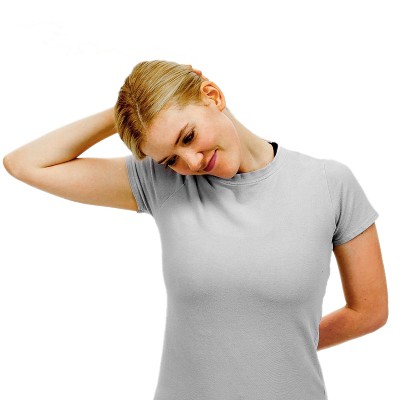
Upper Trapezius Stretch
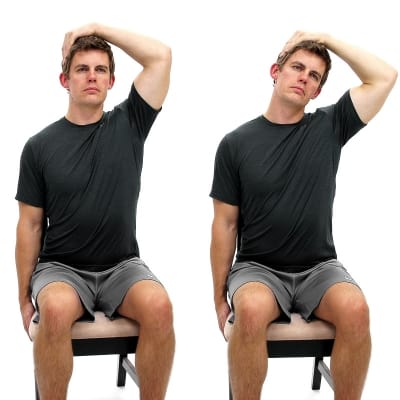
Sit on a chair with one hand holding the seat. Tilt your head to the opposite side, bringing your ear towards your shoulder. You can gently pull your head with your other hand for a deeper stretch. This helps to stretch the upper trapezius, which often becomes tight in UCS.
Levator Scapulae Stretch
Sit on a chair, holding the seat with one hand. Turn your head to look into your armpit on the opposite side, then gently pull your head forward with your other hand to deepen the stretch. This targets the levator scapulae, a muscle at the back of your neck that can contribute to UCS when tight.
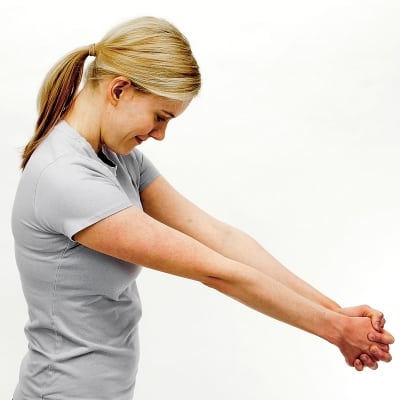
Rhomboid Stretch
Extend your arms out in front of you and clasp your hands together. Round your upper back and push your hands forward until you feel a stretch between your shoulder blades. This helps to stretch the rhomboids, muscles in your upper back that can become tight and contribute to UCS.
Remember, consistency is key when it comes to stretching. Regularly performing these stretches can help alleviate the muscle imbalances associated with UCS, leading to improved posture and cycling performance.
Step Three: Implement a Muscle Activation Regimen
Before hopping on your bike, it’s crucial to stimulate the underactive muscle groups associated with Upper Crossed Syndrome (UCS). This process, known as muscle activation, can enhance muscle function and improve your cycling performance. Primarily, you should focus on the deep neck flexors, rhomboids, and lower trapezius muscles. Visualize these muscles firing to improve contraction strength through enhanced fiber recruitment.
Here’s a suggested routine:
Deep Neck Flexor Activation: Lie on your back with your knees bent. Tuck your chin in towards your chest and lift your head off the ground about an inch. Hold for a few seconds, then lower your head back down. This exercise targets the deep neck flexors, which are often weak in UCS.
Rhomboid Activation: Stand with your arms extended in front of you at shoulder height. Pull your shoulder blades together as if you’re trying to hold a pencil between them. Hold for a few seconds, then relax. This exercise targets the rhomboids, muscles in your upper back that are often underactive in UCS.
Lower Trapezius Activation: Lie on your stomach with your arms extended out to the sides, forming a “T” shape. Lift your arms off the ground, squeezing your shoulder blades together. Hold for a few seconds, then lower your arms back down. This exercise targets the lower trapezius, a muscle in your upper back that’s often underactive in UCS.
Remember to perform each exercise slowly and with control, moving through the full range of motion. The goal is to warm up and engage the specific muscle groups without causing fatigue.
Key Tips for Muscle Activation:
- Pre-activation aims to awaken and stimulate the correct muscles by focusing on a full contraction.
- Perform each movement slowly and deliberately, ensuring maximal contraction through the full range of motion.
- Concentrate on the muscles you’re trying to activate. Visualize them contracting and releasing.
- Maintain constant tension throughout all phases of the movement.
By incorporating these muscle activation exercises into your pre-ride routine, you can help counteract the effects of UCS, leading to improved posture and cycling performance.
Step Four: Implement a Strengthening Regimen
To counteract the effects of Upper Crossed Syndrome (UCS) and enhance your cycling performance, it’s essential to incorporate a strengthening routine into your training regimen. This routine should target the muscles that tend to be weak in UCS, namely the deep neck flexors, rhomboids, and lower trapezius. Here’s a suggested routine:
Chin Tuck (seated or supine)
The chin tuck exercise is a simple yet effective way to improve posture and neck alignment. Here’s how to perform it in both seated and supine positions.
Seated Position
- Sit Upright: Find a chair with good back support. Sit at the edge of the seat and keep your feet flat on the floor.
- Align Your Posture: Straighten your spine and align your head over your shoulders.
- Perform the Chin Tuck: Gently tuck your chin to your chest by pulling your head straight back. Imagine a string pulling the crown of your head toward the ceiling.
- Hold and Release: Hold the position for 5-10 seconds, feeling a gentle stretch in the back of your neck. Release and return to the starting position.
Repeat: Perform 8-10 repetitions.
Supine Position (Lying Down)
- Lie Down: Lie on your back on a firm surface, such as a mat or a firm bed, with your knees bent and feet flat on the floor.
- Align Your Posture: Ensure your spine is neutral and align your head with your body.
- Perform the Chin Tuck: Similar to the seated position, gently push back against a rolled towel and tuck your chin to your chest without lifting your head off the surface.
- Hold and Release: Hold the position for 5-10 seconds, then release.
Repeat: Perform 8-10 repetitions.
Elastic Band Pull Downs with Shoulder Blade Pinch
Grasp the elastic band with your arms outstretched above your shoulders. Pull the band downward, bend your elbows, and pull your shoulder blades together.
Activate the scapular stabilizer muscles and train your shoulder blade to the proper down and back position.
Elastic Band Bilateral Shoulder External Rotation
Start by standing up straight with palms facing each other and elbows bent to 90 degrees. Extend your elbows against the resistance of the elastic band as you move your hands behind your hips and squeeze your shoulder blades down and back.
Strengthen the scapular stabilizers, and open the chest to prevent rounding of the shoulders.
Bilateral Prone T
Begin by lying face down with your arms extended out to the side. Contract the muscles of your shoulder blades and bring them in and back while slowly raising your arms toward the ceiling.
Isolate the middle trapezius and rhomboid muscles to effectively and efficiently strengthen and stabilize your shoulder blades.
Bilateral Prone Y
While lying face down with arms outstretched upwards, slowly raise your arms toward the ceiling as you squeeze your shoulder blades down and toward your spine.
Strengthen the scapular stabilizer and posterior shoulder muscles to give your mid-back the support it needs for long rides.
Conclusion—Upper Crossed Syndrome in Cyclists
In the world of cycling, performance is often the primary focus. However, it’s essential to remember that our bodies are more than just machines that power our bikes. They are complex systems where every part plays a role in maintaining balance and function. When we spend long hours in the saddle or at our desks, specific muscle groups can become overworked, leading to imbalances affecting our cycling performance and overall health. One such condition cyclists should know is Upper Crossed Syndrome (UCS).
UCS, characterized by a specific muscle weakness and tightness pattern, can result from the prolonged forward-leaning position common in cycling and other sedentary activities. This syndrome can lead to inefficient movement, decreased power output, and increased risk of injury. But the good news is, with the proper knowledge and tools, it’s preventable and manageable.
Understanding the concepts of dynamic muscle shortening and reciprocal inhibition, which are fundamental to our neuromuscular coordination, can help us optimize our cycling performance. However, we can restore muscle balance and preserve these essential physiological mechanisms by implementing targeted stretching, strengthening, and muscle activation routines.
Remember, the key to managing UCS is consistency. Regularly incorporating these exercises into your training routine can make a significant difference in preventing and managing this syndrome. So, next time before you hop onto your bike, take a few moments to stretch, activate, and strengthen your muscles. Your body and your cycling performance will thank you for it.
To subscribe to the Zommunique and receive more informative and entertaining articles like this one sent directly to your inbox, click here!
Semi-retired after more than 20 years as the owner and director of a private Orthopedic Physical Therapy practice, Chris now enjoys the freedom to dedicate himself to his passions—virtual cycling and writing.
Driven to give back to the sport that has enriched his life with countless experiences and relationships, he founded a non-profit organization, TheDIRTDadFund. In the summer of 2022, he rode 3,900 miles from San Francisco to his “Gain Cave” on Long Island, New York, raising support for his charity.
His passion for cycling shines through in his writing, which has been featured in prominent publications like Cycling Weekly, Cycling News, road.cc, Zwift Insider, Endurance.biz, and Bicycling. In 2024, he was on-site in Abu Dhabi, covering the first live, in-person UCI Cycling Esports World Championship.
His contributions to cycling esports have not gone unnoticed, with his work cited in multiple research papers exploring this evolving discipline. He sits alongside esteemed esports scientists as a member of the Virtual Sports Research Network and contributes to groundbreaking research exploring the new frontier of virtual physical sport. Chris co-hosts The Virtual Velo Podcast, too.


Hi, great article. I hope this will help me after almost two years with aches and pains!
1. How many sets and reps do you recommend for the strengthening regimen?
2. How many times per week would you recommend the exercises?
3. After how long should you start feeling progress and less symptoms?
4. Would you recommend to take time off the bike while working on this? (For me even short 30 min rides will trigger symptoms)