Cycling esports platform indieVelo innovates with customizable "Neutral Zones", the solution for those seeking the thrill of Keirin and calm race rollouts.
IndieVelo is once again shaping the future of the virtual sport by pushing the cycling esports needle and tackling an online racing issue simultaneously. Have you ever heard of Keirin cycling? If you haven’t, you should.
If you’ve raced online, chances are you’ve been caught out, perhaps barely rolled from the pen, before the field sprinted away, never to be seen again.
Good news: the September 4, 2023, game update V0.2.13 brings customizable “Neutral Zones” to the table. It’s the solution for those looking for the thrill of Keirin-style racing and the calm of smoother race starts.
The History and Structure of Keirin Racing
Keirin Cycling is a fascinating discipline that originated primarily as a wagering event in Japan. Over the years, it has gained international recognition, even becoming an Olympic event in the Sydney 2000 games.
The sport is a unique blend of speed, strategy, and spectacle, and it has a massive following, especially in Japan, where events draw millions of fans and generate billions of yen in bets.
The basic structure of a traditional Keirin race involves eight laps and usually features six riders. The race starts with riders held at the starting line by helpers. Before the race begins, riders draw lots to determine their initial positions behind a pacing vehicle, commonly known as a “derny.”
The Basics
A traditional Japanese Keirin is an 8-lap race involving six riders. The race has three distinct phases:
- The Start: Riders draw lots to determine their initial position behind a pacing vehicle, known as a “derny.”
- Pacing Phase: Riders follow the derny for the first 5.5 laps, which gradually accelerates to about 45-50kph.
- Sprint Phase: The derny leaves the track, and riders sprint to the finish line for the remaining 2.5 laps.
The race has three main phases. The first phase is the initial positioning behind the derny. Riders must settle into the order determined by the lots they drew.
The second phase involves pacing. The riders follow the derny for the first 5.5 laps, which gradually increases its speed, reaching about 45kph for women and 50kph for men. During this phase, riders are not allowed to overtake the derny and must maintain their positions.
The third and final phase is the sprint to the finish line. Once the derny leaves the track, the riders are free to sprint for the remaining 2.5 laps. Here’s where the race becomes intense, with riders jostling for position, often resulting in crashes and close finishes.
What sets Keirin apart from other cycling events is the unique skill set it requires. While good sprinters often do well in Keirin, the best Keirin riders are not always the best sprinters. The Keirin demands more than just speed; it requires tactical awareness, courage, and the ability to maintain high speeds over a longer distance than typical sprint races.
In terms of international competition structure, the Olympic Keirin event starts with 30 riders divided into five heats of six riders each. The top two finishers from each heat advance to the second round, and those who don’t qualify have another chance in the ‘repechage’ heats. The competition narrows down through subsequent rounds, leading to a final race where the medals are on the line.
One of the great aspects of virtual cycling is its limitless potential. It’s a video game, after all. With the right tools from the developers, the sky is truly the limit.
Creating a Keirin-style event or neutralized rollout is straightforward. Anyone can create a custom event on indieVelo. Follow the step-by-step instructions here to create, organize, promote, and broadcast/stream a race or group ride.
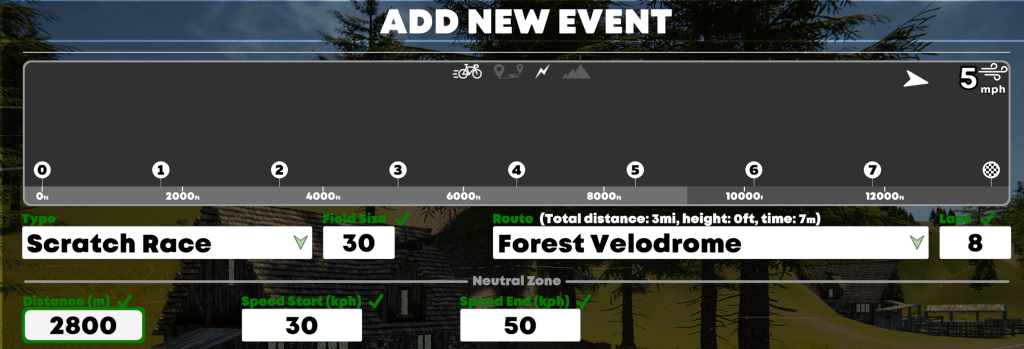
Once you’re in the Add New Event Screen>Event Set Up, you’ll find a new section where you can configure Neutralized Start distance (m), starting speed (kph), and ending speed (kph).
Notice that the neutralized segment is light gray in the picture of a traditional Keirin competition format event setup. The dynamic illustration makes finding the perfect derny delivery simple.
The same applies to rolling starts in scratch and other race formats as shown in the picture above.
The Sky's The Limit
Now that you know what and how to do it, the rest is up to you. A friendly wager, anyone? There are already several exciting and creative projects in the works. Watch this space!
Semi-retired after more than 20 years as the owner and director of a private Orthopedic Physical Therapy practice, Chris now enjoys the freedom to dedicate himself to his passions—virtual cycling and writing.
Driven to give back to the sport that has enriched his life with countless experiences and relationships, he founded a non-profit organization, TheDIRTDadFund. In the summer of 2022, he rode 3,900 miles from San Francisco to his “Gain Cave” on Long Island, New York, raising support for his charity.
His passion for cycling shines through in his writing, which has been featured in prominent publications like Cycling Weekly, Cycling News, road.cc, Zwift Insider, Endurance.biz, and Bicycling. In 2024, he was on-site in Abu Dhabi, covering the first live, in-person UCI Cycling Esports World Championship.
His contributions to cycling esports have not gone unnoticed, with his work cited in multiple research papers exploring this evolving discipline. He sits alongside esteemed esports scientists as a member of the Virtual Sports Research Network and contributes to groundbreaking research exploring the new frontier of virtual physical sport. Chris co-hosts The Virtual Velo Podcast, too.