
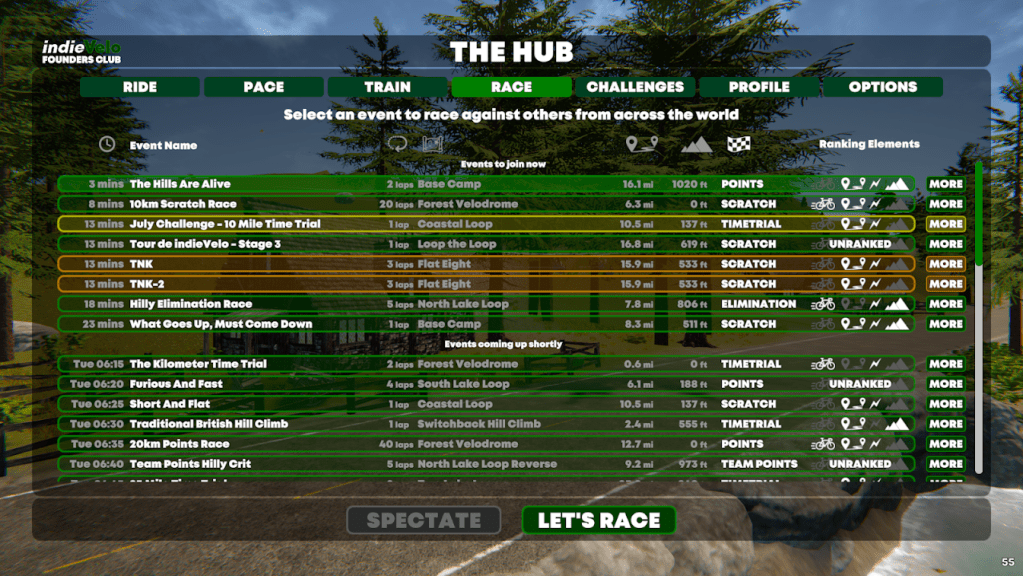


indieVelo is defining the future of cycling esports with its unique Race Ratings for results-based categorization and Rankings system.
indieVelo’s developers and its Beta-tester community are working to define the future of cycling esports. The virtual cycling platform’s innovative advancements in esports racing are transforming how esports racers and enthusiasts view the evolving sport. Its developer measures the significance of the forward-thinking evolutions against one standard, “Imagine if online cycling were an Olympic sport.” indieVelo’s unique Race Rating and Ranking system is a step toward the goal.
indieVelo—Race Ratings
indieVelo utilizes a proprietary rating algorithm to track a racer’s performance abilities to ensure proper matchmaking. The cycling esports platform doesn’t use your FTP or other power-to-weight metrics to determine categorization.
Instead, indieVelo employs a simple yet potent matchmaking system that pairs racers of comparable skills, ensuring consistently thrilling and captivating races. On the surface, it’s incredibly straightforward.
- If you beat riders rated higher than you, you move up in rating.
- If you lose to riders rated lower than you, you move down in rating.
indieVelo's Elo-like Rating System
indieVelo’s Elo-like rating system, as applied to cycling esports, is a method for calculating the relative skill levels of players in competitor-versus-competitor games. Each rider starts with a base rating, which goes up or down depending on whether they win or lose races.
The amount it changes depends on the rating of the cyclists they’re racing against. If a lower-rated cyclist beats a higher-rated one, they gain more points than if they beat someone of a similar or lower rating.
The system ensures that cyclists are matched with competitors of similar skill levels, making each race challenging and exciting. indieVelo’s system also penalizes a racer’s ranking for dropping out—after completing 30 percent—of the race, relegating the rider to last place.
Your First indieVelo Race
For your initial race, matchmaking relies solely on your configured weight and FTP, so it’s crucial to set these accurately before participating in any events. From your second race onwards, matchmaking is determined entirely by past performance in events, with no other factors considered, including experience.
Five Key Facts About indieVelo's Rating and Ranking System
- Unique Rating System: indieVelo uses a proprietary rating algorithm for matchmaking, which pairs racers based on their performance abilities rather than traditional power-to-weight metrics. The system is similar to the Elo rating system used in chess, where a racer’s rating increases or decreases based on race outcomes.
- Initial Race Matchmaking: For a racer’s initial race, matchmaking is based solely on their configured weight and FTP. From the second race onwards, matchmaking is determined entirely by past performance in events, disregarding other factors such as experience.
- Performance Tracking Across Race Scenarios: indieVelo tracks a racer’s performance across different race types such as Sprints, Endurance, Time Trials, and Climbing. Each type has its own rating, and these ratings are used to match racers with suitable competitors.
- Dynamic Ranking System: indieVelo’s ranking system is dynamic and comparative, reflecting a racer’s performance against other riders rather than an absolute measure of ability. Rankings can fluctuate based on the evolving skill levels of competitors, encouraging continuous improvement.
- Ranking Levels: There are five ranking levels (Carbon, Bronze, Silver, Gold, Platinum, Diamond), each with three sub-levels. New racers start at the first level of the Carbon ranking in all four categories and progress based on their event performance.
indieVelo's Rating System Tracks Performance in Multiple Race Scenarios
Results-based matchmaking removes the motivation for cheating and sandbagging. If a racer’s performance is artificially exaggerated, the game puts that rider in a pen against more skilled riders. indieVelo calculates a racer’s rating behind the scenes to avoid performance manipulation. However, knowledge of the factors the game takes into account is essential to optimizing success.
indieVelo keeps track of your skills in different race types like Sprints, Endurance, Time Trials, and Climbing, each with its rating. These ratings are weighted to match you with competitors in events that best fit your abilities. For example, your Sprint rating will be the main factor if you’re in a short elimination race. But your Endurance and Climbing ratings will be more critical for a long race with many hills.
- Sprint Rating: Reflects how you perform in short races. Sprinting at the end of long races doesn’t affect this rating.
- Endurance Rating: This is how you do in longer races.
- Time Trial Rating: It’s all about your performance in races on flat terrain.
- Climbing Rating: Determined by how well you do in races with climbs. Remember that the climb’s steepness matters more than the total height you climb. So, a race with one steep 10% climb will affect this rating more than a race with five smaller 2% climbs.
Since most races aren’t purely about sprinting, endurance, time trialing, or climbing, indieVelo’s system calculates the significance of the varied characteristics of each race. For instance, a shorter race might be 82% Sprint and 18% Endurance. Even though it’s a Sprint event in indieVelo’s Race Hub, your Endurance rating may change slightly.
Also Read: indieVelo—Racebots Explained!
"indieVelo does not have fixed categories. Events are adapted to you, guaranteeing that you race humans and smart Racebots with a similar power curve and performance level. By doing so, not only are all races challenging and entertaining, but also the notion of sandbagging is eradicated since there are no fixed thresholds or maximums that you would be able to anticipate. In a way, indieVelo does not place riders into categories but creates one customized virtual and dynamic category around each rider."
Beta-tester Luciano Pollastri
indieVelo—Rankings
indieVelo’s advanced race rating system does the work to set you up for success, but it’s your responsibility to get the job done. Your ranking will improve when you do, filling your virtual trophy case.
A racer’s indieVelo ranking represents their overall experience and rating. There are five rankings (Carbon, Bronze, Silver, Gold, Platinum, Diamond), each with three levels. As a new racer on indieVelo, you’ll start at the first level of the Carbon ranking in all four categories.
As you participate in more events on indieVelo, your ranking will progressively rise to match your underlying rating. Once it reaches this point, your ranking will fluctuate based on your performance in events, specifically how well you fare against your competitors’ abilities.
It’s important to understand that your ranking is a comparative measure, reflecting how you stack up against other riders rather than an absolute measure of your ability. A racer’s ranking is dynamic and can decrease even if they’re improving.
For instance, if the riders you regularly compete against are improving more rapidly than you, your ranking might drop despite your progress. This system encourages continuous improvement and adaptation to the evolving skill levels of your competitors.
Conclusion—indieVelo Race Ratings and Rankings
indieVelo is revolutionizing the world of cycling esports with its innovative Race Rating and Ranking system. By focusing on performance-based matchmaking, the platform ensures thrilling and fair races while discouraging cheating and sandbagging.
The platform’s Elo-like rating system, which adjusts based on race outcomes, and its multi-faceted ranking system, which reflects a racer’s overall experience and rating, provide a comprehensive and dynamic measure of a racer’s abilities.
As indieVelo continues to refine its platform, it is setting the standard for the future of virtual cycling, bringing us closer to a world where online cycling could be an Olympic sport.
Semi-retired after more than 20 years as the owner and director of a private Orthopedic Physical Therapy practice, Chris now enjoys the freedom to dedicate himself to his passions—virtual cycling and writing.
Driven to give back to the sport that has enriched his life with countless experiences and relationships, he founded a non-profit organization, TheDIRTDadFund. In the summer of 2022, he rode 3,900 miles from San Francisco to his “Gain Cave” on Long Island, New York, raising support for his charity.
His passion for cycling shines through in his writing, which has been featured in prominent publications like Cycling Weekly, Cycling News, road.cc, Zwift Insider, Endurance.biz, and Bicycling. In 2024, he was on-site in Abu Dhabi, covering the first live, in-person UCI Cycling Esports World Championship.
His contributions to cycling esports have not gone unnoticed, with his work cited in multiple research papers exploring this evolving discipline. He sits alongside esteemed esports scientists as a member of the Virtual Sports Research Network and contributes to groundbreaking research exploring the new frontier of virtual physical sport. Chris co-hosts The Virtual Velo Podcast, too.